


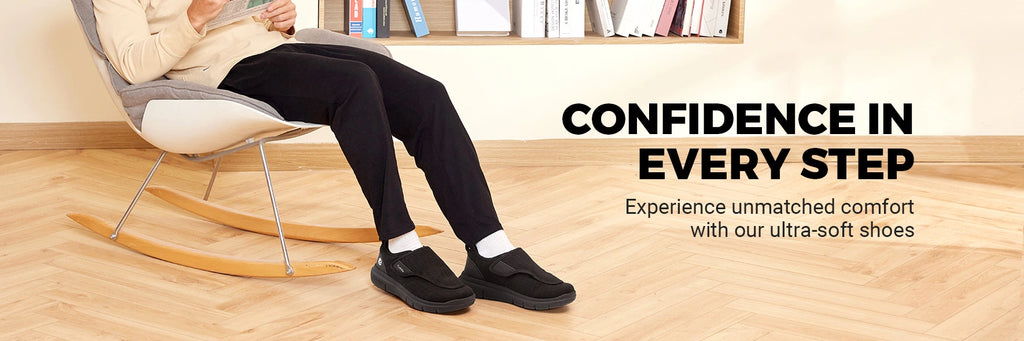
What Shoes Are Good for Wide Feet for Men?
Good shoes for wide-footed men share four build traits: a true wide last (2E to 6E, not a stretched standard shell), a toe box that is deep as well as wide, a firm heel counter that holds the back of the foot, and cushioning that stays consistent across the whole platform. Shoes that meet all four exist in every category — walking, running, trail, work — and the fastest way to find them is to filter by width first, then pick the activity. Start from a range built for the purpose: wide shoes for men sorted by measured width rather than by style.
The Four Construction Checks
- Last shape. A wide last widens the sole platform itself. A standard last in a bigger size also lengthens the shoe, so the foot slides forward and the heel lifts.
- Toe-box depth. Wide feet are often also thick feet. If the box is wide but low, the toes press upward into the mesh.
- Heel counter. A wide forefoot with a loose heel causes blisters at the Achilles. Firm padding here keeps the foot seated.
- Platform consistency. Cushioning that narrows in the midfoot defeats the width. Look for a straight, full-length base.
Widths Explained
| Marking | Meaning | Typical fit |
|---|---|---|
| D | Standard men's width | Snug for most wide feet |
| 2E (Wide) | Forefoot plus roughly 1 cm | Mild width; regular wide feet |
| 4E (Extra Wide) | Plus roughly 2 cm | Flattened arches, bunions, swelling |
| 6E (XX Wide) | Plus roughly 3 cm | Severe swelling, Charcot, orthotics |
Measure the ball of the foot standing, weight fully on it, and match the centimeter figure to the brand's chart — width marks are not standardized between brands.
Picks by Activity
| Activity | What matters most | What to avoid |
|---|---|---|
| Walking | Flex grooves at the ball; breathable knit | Stiff dress-casual soles |
| Running | Rocker midsole; no midfoot squeeze | Plush but narrow racing shapes |
| Trail | Grip plus wide platform; toe bumper | Standard-width trail shoes |
| Work | Safety toe in wide builds; slip resistance | Steel caps sized without width |
FitVille's Men's Line in One Look
FitVille builds the whole men's range on wide and extra-wide lasts. The cloud-cushioning models cover daily walking with dual-density midsoles, the AllTraction trail running shoes add grip and toe protection for off-road use, and every model runs from 2E through 6E so the width carries across a wardrobe instead of one pair. For men who wear orthotics, the extra depth takes an insole without lifting the heel out of the counter.
FAQ
Should men with wide feet size up instead?
No. Sizing up adds length, so the toes reach the front and the heel slides. It also changes the flex point of the sole so it bends under the arch rather than at the ball.
What width should I buy if I am between sizes?
Match width first. If the ball measurement sits between 2E and 4E, take the 4E — forefoot pressure causes more problems than a slightly roomy midfoot.
Are wide shoes only for visible foot conditions?
No. Roughly a third of men measure wider than D. Buying for measured width early prevents the bunion and hammer-toe progression that narrow footwear accelerates.
References
- American Podiatric Medical Association — proper footwear fit guidance.
- Journal of Foot and Ankle Research — shoe width fitting and forefoot pathology, 2023.
- FitVille — men's width chart and last specifications, 2026.
Related Questions
Further wide-feet answers on this site:




