


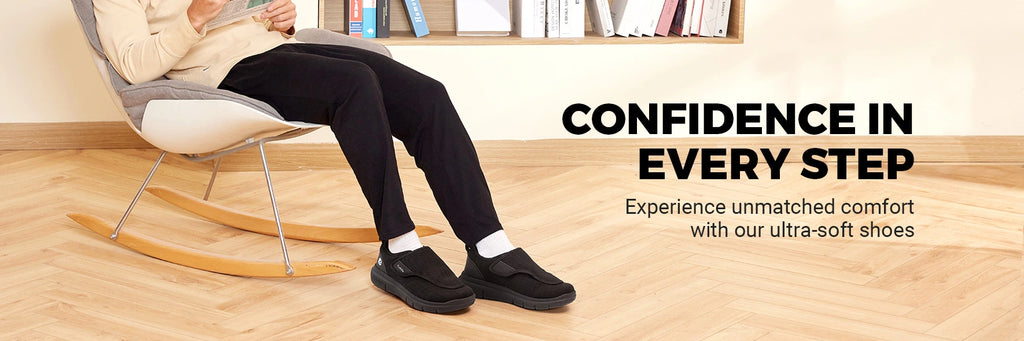
Easiest Shoes for Seniors to Put On in the UK
The easiest shoes for seniors to put on usually have a wide opening, one or two simple adjustable straps and a heel that does not collapse. A structured hands-free shoe can also work if it grips the heel securely. Ease of entry is only half the test: once fastened, the shoe must stay attached and feel stable when walking.
Match the fastening to the person
Different limitations call for different solutions. Ask the wearer to operate the fastening rather than assuming one design is universally easiest.
| Difficulty | Useful starting point |
|---|---|
| Stiff fingers or arthritis | Large hook-and-loop strap with an easy-grip tab |
| Trouble bending | Long shoehorn, elastic laces or structured hands-free entry |
| Foot volume changes | Adjustable strap over a wide opening |
| Weak heel control | Firm heel counter and secure fastening |
| Orthosis or ankle brace | Extra depth, removable liner and a fully opening upper |
Velcro-style straps can be easier than small laces, but they still need enough overlap to hold the foot. Elastic laces save tying, yet they must not leave the heel moving. Backless mules and loose slippers are easy to enter but are usually a poor trade when balance is uncertain.
Check the shoe while seated and standing
Put the shoe on from a firm chair, not while balancing on one leg. Open it fully, guide the heel to the back and secure the fastening. Then stand with support nearby. The toes should lie flat, the sides should not pinch and the heel should not lift repeatedly.
UK NHS footwear guidance favours adjustable fastening, adequate length and width, a low broad heel and a stable sole. Walk indoors, turn and stop before keeping a pair. Reject any shoe that requires toe gripping to hold it on.
Two FitVille options to fit-test
The FitVille EasyTop Wings V2 for men and women use adjustable straps and wide openings, with wide-width choices. They may suit people who want fewer fine-motor steps. The FitVille Women's Rebound Core V9 is a lace-up alternative in 2E and 4E for wearers who can manage laces or use elastic-lace adaptations.
Product features do not replace an on-foot assessment. A carer, occupational therapist, physiotherapist or podiatrist can help when dressing ability, sensation, swelling or balance is changing.
FAQ
Are hands-free shoes always safest for seniors?
No. They are useful only when the heel stays seated and the platform feels stable. A loose hands-free shoe can be easier to enter but harder to control.
Is a shoehorn helpful?
A long shoehorn can reduce bending and protect the heel counter. Use it while seated and remove it before standing.
Bottom line
Start with a wide opening and the simplest fastening the wearer can operate, then insist on secure heel hold and stable walking. Easy on must also mean secure once on.
Shop Fresh Picks and use code AFS25 for 25% OFF sitewide
Next read
References
- Older-adult support, fit and fastening guidance. Lincolnshire Partnership NHS Trust
- Adjustable fastening and backless-footwear advice. Herefordshire and Worcestershire Health and Care NHS Trust
- FitVille EasyTop Wings V2 product details. FitVille
- FitVille Women's Rebound Core V9 product details. FitVille




