


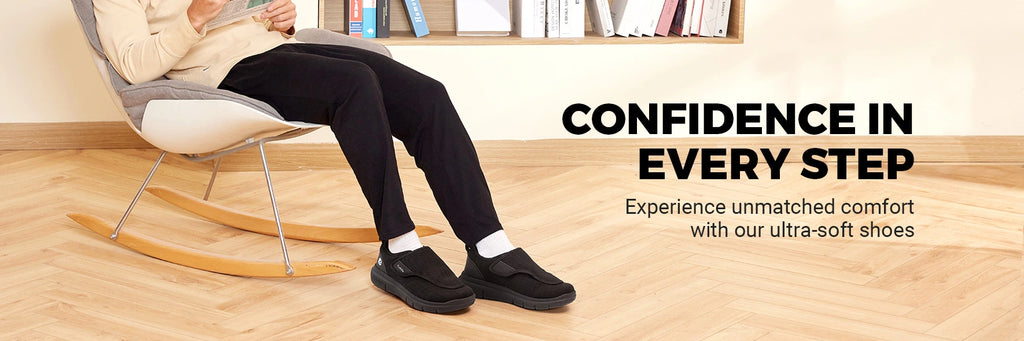
Best Wide-Fit Shoes for Hallux Rigidus in the UK
The best wide-fit shoes for hallux rigidus combine accurate width with the other features the condition requires. Width can stop pressure on a swollen big-toe joint or dorsal bump, but hallux rigidus also needs enough depth and often a stiff or rocker-style sole to limit painful joint movement. Choose by measured fit and on-foot testing rather than a wide label or a list of popular brands.
Build the full shortlist
| Feature | Why it matters |
|---|---|
| Appropriate toe-box width | Avoids side compression at the big-toe joint |
| Extra toe-box depth | Reduces rubbing over a dorsal bony prominence |
| Stiff or rocker-style sole | Limits bending through the painful joint |
| Low heel | Avoids extra forefoot and big-toe loading |
| Secure fastening and stable heel | Keeps the foot positioned during rollover |
A shoe can pass the width test and still fail because it is too shallow, unstable or loose at the heel. Avoid high heels, thin very flexible soles, stiff seams over the joint and assuming extra width alone will reduce joint movement. Rocker geometry must feel stable for the wearer.
Fit the shoe, not the diagnosis
Test the shoe on level ground and during normal rollover. The upper should clear the joint, the heel should stay seated and the sole should reduce uncomfortable big-toe bending without feeling unstable.
Compare widths within the same model when possible. Keep the length aligned with the larger foot and reject any pair that creates pressure marks, repeated heel lift or sliding. A retailer with a suitable indoor-return policy makes a careful trial easier.
A FitVille option to assess
The FitVille Women's Rebound Core V9 lists 2E and 4E widths, a removable insole and a broad platform. Those specifications make it one candidate to fit-test; they do not show that its arch shape, depth or cushioning will suit every foot.
No product should be presented as universally best. A podiatrist or foot-and-ankle clinician may assess joint movement, the bony prominence, gait and X-rays before advising a stiff sole, rocker, insole or footwear adaptation. Seek advice when pain persists despite footwear changes, the joint becomes increasingly swollen, walking changes substantially, skin breaks over the prominence or another diagnosis is possible.
FAQ
Is the widest option automatically best for hallux rigidus?
No. The shoe should remove compression while keeping the heel and midfoot secure. Extra width can create movement when it is not needed.
Should I buy a longer shoe instead of a wide one?
Only when length is genuinely insufficient. Extra length changes heel fit and flex position and is not a reliable replacement for width or depth.
Bottom line
Shortlist shoes that combine suitable width with the condition-specific features above, then keep the pair that remains pressure-free and secure during walking.
Shop Fresh Picks and use code AFS25 for 25% OFF sitewide
Next read
References
- Hallux-rigidus width, depth, rocker and removable-insole guidance. My Joint Health Hub NHS service
- Stiff painful big-toe footwear and rocker guidance. Bradford District Care NHS Foundation Trust
- Deep toe box, stiff sole and orthosis guidance. Royal Orthopaedic Hospital NHS Foundation Trust
- FitVille Women's Rebound Core V9 product details. FitVille




