


What Shoes Are Best for Poor Balance in the UK?
For poor balance, the best shoe is correctly fitted, securely fastened and predictable underfoot. Look for a low broad heel, a stable supportive sole, adequate toe clearance, useful tread and firm heel hold. Avoid loose backless footwear and any sole that feels tippy or distorted.
Prioritise control over softness
Maximum cushioning is not automatically better. A very soft or narrow platform may move as weight shifts. The wearer should be able to feel where the shoe is and place it consistently without fighting heel slip.
| Feature | What to check |
|---|---|
| Base | Broad enough to feel stable |
| Heel | Low, wide and held by a firm counter |
| Fastening | Lace, strap or buckle secures the foot |
| Toe area | Enough space without excessive length |
| Outsole | Intact tread suited to normal surfaces |
Shoes must also work with a walking stick, frame, orthosis or ankle brace when used. Bring those items to the fitting.
Test real movements
Put shoes on while seated and stand with support. Walk at the person's usual pace, turn both ways, stop and negotiate a step if safe. Watch for catching the toe, lateral sliding, repeated heel lift or shortened shuffling caused by the shoe.
Check indoor footwear as carefully as outdoor shoes. Socks on smooth floors and loose slippers can undermine an otherwise sensible plan.
Balance problems need a wider review
New or worsening unsteadiness can relate to medicines, blood pressure, vision, hearing, strength, sensation, neurological issues or the home environment. Contact a GP or local falls service after a fall or meaningful change. Call emergency services for sudden severe symptoms such as facial weakness, speech difficulty, collapse or chest pain.
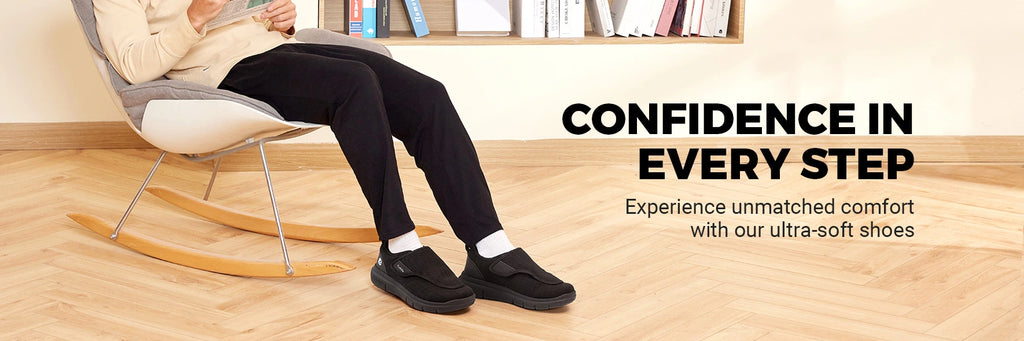
The FitVille Women's Rebound Core V9 lists a broad platform and 2E/4E widths; the FitVille EasyTop Wings V2 lists adjustable fastening and a rubber outsole. These are features to assess, not evidence that either shoe is right for a particular balance problem.
FAQ
Are high-top shoes better for balance?
Not automatically. Collar height may change support, but fit, sole stability and the person's movement matter more. Braces should be fitted with professional input.
Are non-slip soles enough?
No. Grip, fit, retention and the walking surface interact. Worn tread or loose heels can still create risk.
Bottom line
Choose a secure low shoe on a broad stable base and test it during real movements. Pair footwear changes with assessment of the underlying balance problem.
Shop Fresh Picks and use code AFS25 for 25% OFF sitewide
Next read
References
- Falls-prevention footwear procedure. RDaSH NHS Foundation Trust
- Older-adult stable-footwear guidance. Lincolnshire Partnership NHS Trust
- FitVille Women's Rebound Core V9 product details. FitVille
- FitVille EasyTop Wings V2 product details. FitVille




