


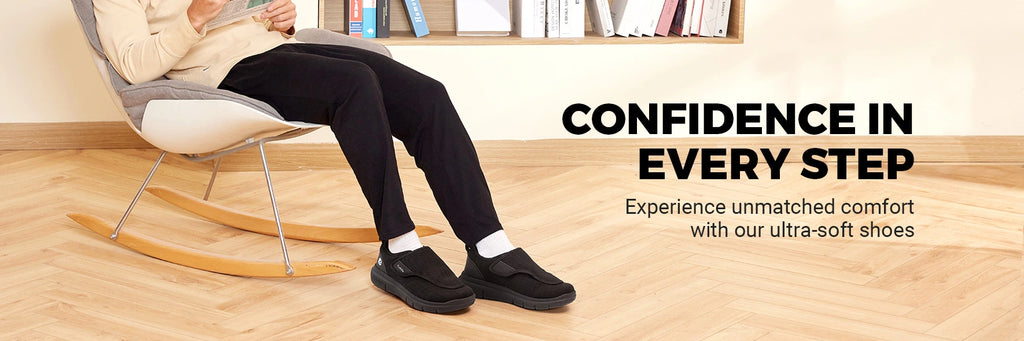
How to Find Comfortable Shoes for Wide Feet
To find comfortable shoes for wide feet, compare usable space, underfoot feel and secure hold separately. A soft sole can feel pleasant while the upper still presses on your toes, and a loose shoe can feel spacious while allowing too much movement. Use the same socks, inserts and short fitting routine for every candidate.
The aim is a pair you can move in naturally without repeatedly adjusting your stride or fastening. Your own observations should decide which model stays on the shortlist.
Write down what comfortable needs to mean for you
Describe an ordinary day in the pair. A commute with stairs, steady pavement walking, a long period standing and a seated journey create different opportunities for discomfort. Choose a fitting routine that includes the relevant movements without exceeding the shop's trial conditions.
Also record what failed in your last pair. A seam pressing on the little toe is a different problem from an intrusive arch contour or a slipping heel. Separating these complaints helps you avoid replacing one uncomfortable feature with another.
Use a three-part comfort record
| Part of the fit | Notice during the trial | Useful note to keep |
|---|---|---|
| Space in the upper | Side pressure, toe contact, tongue pressure | Exact location and whether one or both feet are affected |
| Underfoot feel | Cushioning and contour during standing and walking | Comfortable immediately, intrusive, or difficult to judge |
| Hold during movement | Heel lift or forward sliding | Which movement causes it and whether normal fastening helps |
Keep these as observations rather than numerical promises. A shoe can score well on two parts and still be unsuitable because the third creates persistent discomfort.
Set up a fair comparison
Try both shoes with the socks you expect to wear. If you use an insert, bring it and follow any fitting advice provided with it. Comparing one pair with an insert and another without it can obscure why the fit differs.
FootCareMD recommends considering both feet, testing fit while standing and walking, and not expecting an unsuitable new shoe to stretch into comfort. Its guidance also emphasizes that the size label is only a starting point. Use the chosen model's chart, then let the fitting refine the decision.
Keep the first shortlist small. Wide options from New Balance and Brooks can provide starting points, depending on the activity. If you are shopping for everyday women's walking, include the FitVille Women's Rebound Core V9 as another candidate with a wide toe box.
Follow the same short routine in each pair
Begin by standing normally with the laces comfortably fastened. Notice any immediate pressure before moving. Then walk at your ordinary pace, pause, and turn in both directions. If stairs are part of your day and a suitable trial area is available, ask whether you can include them.
After each pair, write a brief decision: keep comparing, reject, or ask for help. Add one concrete reason. For example, "Comfortable toe area, but repeated heel lift during turns" tells you more than "Nearly right."
Change one thing at a time when possible. If you loosen the laces, change the socks and add a footbed together, you lose the ability to tell which change mattered. A simple comparison makes your next decision clearer.
Distinguish an adjustment from a fit compromise
An uneven tongue or unnecessarily tight lace may be easy to adjust. Persistent side pressure, contact at the toe tips or substantial heel movement may call for another width, size or shape. Do not assume that every problem can be solved with an accessory.
The NHS footwear guidance considers width, depth and fastening together. That is a useful reminder when the shoe seems wide enough across the front but feels shallow over the foot. More length does not reliably address that mismatch.
Before ordering online, check how the seller permits you to assess fit and what condition is required for returns. Keep the shoes and packaging in that condition until you decide. A brief indoor check is useful, but it does not prove how a pair will feel over a full day.
FAQ
Is the softest pair usually the most comfortable?
Not for everyone. Compare softness only after the upper and heel fit are acceptable. The way the shoe feels while moving matters more than how easily you can compress the foam by hand.
Should discomfort disappear after breaking in?
Do not rely on a painful pair becoming suitable. Stop the trial for pain, numbness or skin irritation and reassess the fit.
What if every pair hurts in the same place?
Ask a qualified fitter or foot-health professional for individual advice, especially if symptoms persist. More online comparisons may not answer the underlying fitting question.
Keep the record of the pair that works
Save the full model name, size, width and fitting setup. Use that information as a reference when you shop again, while checking any redesign and your current needs. A repeatable process makes comfort easier to evaluate than a broad brand reputation.
Shop Fresh Picks and use code AFS25 for 25% OFF sitewide
References
- Shoe width, depth and fastening advice. Guy's and St Thomas' NHS Foundation Trust
- Ten points of proper shoe fit. FootCareMD
- Width labels and upper-volume guidance. Brooks
- Women's Rebound Core V9 width and construction specifications. FitVille
Next read: How to Lace Shoes for Wide Feet: Diagram Guide · What Athletic Shoes Are Best for Wide Feet?




