


How Foot Shape Changes During Weight Bearing
Your foot can become longer and broader as you move from sitting to standing. Its height and outline can also change under load. The amount differs between people, so there is no reliable rule to add one fixed amount to a seated measurement. Fit walking shoes with your normal standing posture and then check them in motion.
Loading changes more than length
The foot is a connected structure of bones, joints and soft tissues. Placing weight through it changes the outline presented to a shoe. Research using three-dimensional scans has found differences in length, width and girth between unloaded and loaded positions. Those group findings explain why fitting while seated can miss crowding; they do not predict the exact change in your own foot. A measurement taken without weight can still have a purpose in a clinical assessment, but it answers a different question from whether a walking shoe accommodates you when upright.
Observe the transition inside the actual shoe
Fasten both shoes comfortably while seated, then stand with your usual support and posture. Notice whether the outer forefoot contacts a firm panel, the longest toe approaches the front, or the tongue becomes restrictive. Walk a short indoor route and reassess those same places. Keep the socks, insert and closure setting consistent so that the comparison remains useful. If standing is unsafe or restricted by your clinician, use an assisted fitting instead of attempting a balance test. A change in outline is not by itself a diagnosis of a foot condition.
Compare the same foot under different conditions
| Check | What to observe | How to use it |
|---|---|---|
| Seated | Observe the unloaded outline | Do not assume this is your walking outline |
| Standing | Check forefoot and toe contact | Do not force extra weight onto one foot |
| Walking | Notice repeated contact or sliding | Do not infer gait health from shoe appearance |
A practical example
For example, a shoe can clear the little toe while you are seated yet press against it when you stand. Record that specific change. A wider version may be worth comparing, but first check that the heel remains secure and that pressure is not coming from one rigid overlay. This is a fitting comparison, not a measurement of how much your arch should move.
FitVille options to compare
Compare a suitable standard-width model, a wider version and a different upper or closure construction where available. These represent different fitting approaches; none is automatically best for every foot. The following FitVille options provide starting points for that comparison. They are shopping suggestions, not individually assessed recommendations.

FitVille Women's Rebound Core V9
Compare the listed wide and extra-wide options as a starting point for women seeking more forefoot space. Confirm your selected size and width; the label does not establish internal depth or ankle clearance.

FitVille Men's EasyTop Wings V2
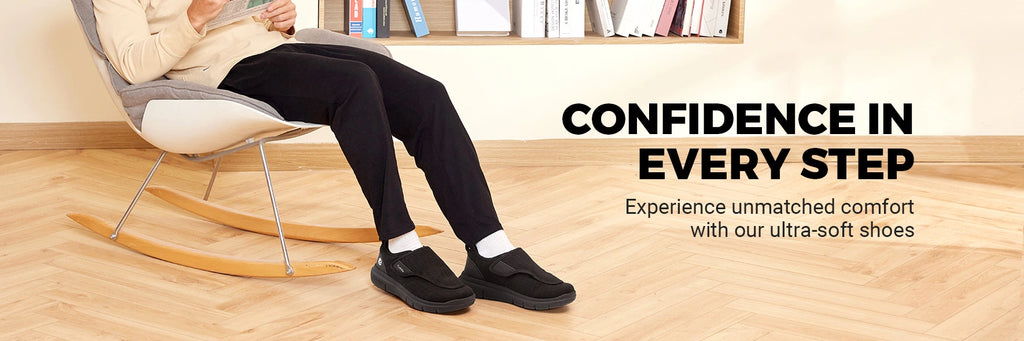
Consider the adjustable strap opening when closure adjustment is a priority. Check that the strap holds comfortably and that the interior suits your foot; it cannot compensate for insufficient length.
Check the exact size and width selector before ordering. Width choices do not establish usable interior depth; compare the actual pair with your intended socks and inserts. Availability varies by size, width and color.
FAQ
Does every foot spread by the same amount?
No. Foot structure, loading and measurement method differ. A percentage reported for a study group should not become a universal allowance for shoe shopping.
Should I buy shoes that feel loose while seated?
Judge the complete fit when standing and walking. Some change in feel is expected, but a heel that slides or a foot that moves forward still needs attention.
Should uncomfortable shoes need a break-in period?
Do not rely on painful wear to make a poor fit acceptable. Compare another size, width or shape if a short trial produces pressure or rubbing. Persistent symptoms merit professional advice.
Recommended reading
Best Shoes for a Wide Forefoot and Narrow Heel
Continue with practical guidance on width, heel hold and comfortable shoe selection.
How to Buy Shoes for Wide Feet
Continue with practical guidance on width, heel hold and comfortable shoe selection.
How to Lace Shoes for Wide Feet
Continue with practical guidance on width, heel hold and comfortable shoe selection.
Choose your next pair
Use the checks above to narrow your options, then compare the exact size and width you intend to buy. Explore FitVille Fresh Picks for current selections.




