


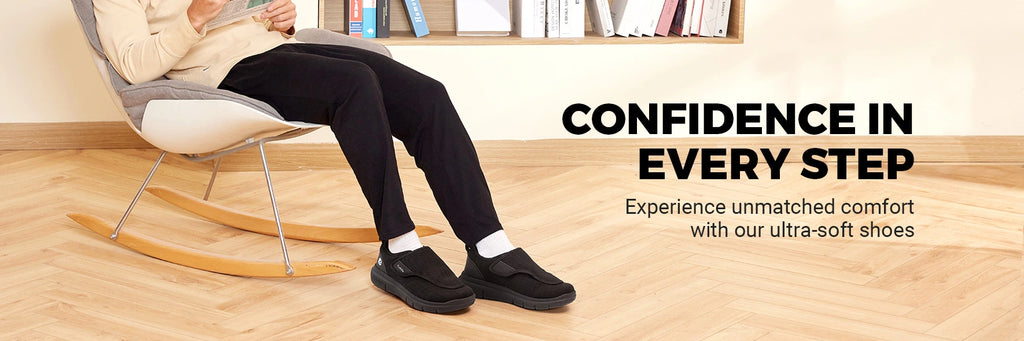
Best Work Shoes for Standing All Day 2026
If you only read two sentences: the best work shoes for standing all day in 2026 are the FitVille Rebound Core V9 (wide toe box plus ergonomic arch support, built for static-load standing rather than a running gait), the HOKA Bondi 9 (deep max-cushion stack for hard floors), the Brooks Ghost Max 3 (soft heel-to-toe transition for standing-and-walking hybrids), the New Balance Fresh Foam X More v6 (tall plush midsole for impact comfort), and the Skechers Max Cushioning Elite (lightweight everyday cushioning at a friendly price band). Each earns its place for a different standing failure mode—keep reading for which one matches your shift.
Standing is not running—and that changes the shoe
Every "best shoes for standing all day" list is really a running-shoe ranking with the word "standing" pasted on top. Standing is its own load problem, and it deserves its own shoe logic.
Here is the physics. Running is a cyclic load: your foot strikes, rolls, and pushes off, and the gait cycle constantly moves pressure around the foot. A running shoe is engineered to manage that moving load—energy return, a propulsive drop, a smooth transition. Walking is gentler but still cyclic: pressure travels heel-to-toe with every step. Standing is the odd one out. It is a static load. There is no gait cycle to redistribute pressure, so your forefoot and arch carry constant, unrelieved weight for hours. The same New Balance Fresh Foam X More v6 that feels brilliant on a 5-mile run can leave your forefoot aching after a 10-hour retail shift, because standing never gives the shoe the movement it was tuned for.
That is why a running shoe "stood in" for 12 hours fails differently than it does on a run. The standing-specific requirements are: constant forefoot support (not just push-off cushioning), all-day arch support that does not fatigue, and a stable platform that does not ask your knees and lower back to compensate.
What fails after 8–12 hours of standing
Map the failure modes to the shoe features and the shortlist below stops being a guess.
- Forefoot swelling and pressure. Static load plus gravity means blood and fluid pool in your feet. Your forefoot spreads. A narrow toe box that fit at hour 0 becomes a clamp by hour 10. Feature requirement: a genuine wide toe box that allows natural toe splay as the foot expands.
- Arch fatigue. With no gait cycle to share the load, the arch holds tension continuously. Feature requirement: ergonomic arch support that distributes load instead of letting the arch collapse and ache.
- Plantar-fascia load. The band along the bottom of your foot stays under constant tension during long static standing. Feature requirement: a supportive footbed and a cushioned heel that reduces pressure on that structure.
- Knee and lower-back compensation. When the foot is unsupported, the body borrows stability from the joints above it. That is the real source of "shoes for standing all day, no back pain" searches. Feature requirement: a stable, shock-absorbing midsole that keeps you from compensating up the chain.
None of this is a medical claim—it is load engineering. The right shoe simply provides support where the static load concentrates.
Browse FitVille's Fresh Picks collection →
Concrete floors vs cushioned mats: the surface matters
Where you stand changes what your shoe needs to do.
Hard flooring—concrete, tile, polished warehouse slab—reflects impact straight back up. There is no give in the surface, so the shoe's midsole stack is your only shock absorption. On concrete, prioritize a tall, shock-absorbing midsole and an outsole with enough material to dampen the floor.
Cushioned anti-fatigue mats, common at fixed workstations, do some of that work for you. If you spend your shift on a mat, you can prioritize a slightly lower, more stable platform over maximum stack height, because the mat is already absorbing impact.
Most standing jobs are a mix—a warehouse picker crosses bare concrete between matted stations all day—so a versatile shock-absorbing midsole is the safe default. If "best shoes for standing on concrete all day" is your exact search, weight the stack height and outsole thickness heavily.
The 2E/4E sizing window most guides skip
Here is the sizing fact almost no running-shoe list mentions: feet swell up to a half-size over a long shift. The shoe you fit at hour 0 and the shoe you need at hour 10 are two different fit problems.
This is why width matters as much as length. A standard D-width shoe that fits your morning foot has nowhere to expand into by late afternoon, and the result is forefoot pressure, hot spots, and numb toes. Buying in 2E or 4E width gives your forefoot a swelling window—room to spread as fluid accumulates—instead of fighting the shoe for the back half of your shift. FitVille builds its standing-focused shoes in 2E and 4E precisely for this reason.
FitVille Rebound Core V9: feature-to-failure mapping
The FitVille Rebound Core V9 is built backward from the standing failure modes above:
- Ergonomic arch support → arch fatigue. Distributes the continuous static load across the arch instead of letting it hold tension in one spot all shift.
- Wide toe box → forefoot swelling. Available in 2E and 4E, it gives your forefoot room for natural toe splay through the back half of a 12-hour shift.
- Shock-absorbing midsole → impact and static-load compensation. A cushioned platform that takes the hit on concrete so your knees and lower back do not have to.
- Slip-resistant outsole → wet industrial and retail floors. Traction for the spilled-drink, mopped-aisle, walk-in-cooler reality of standing jobs.
It is not a running shoe asked to moonlight. It is a standing shoe.
Comparison shortlist: 5 picks for standing all day
| Model | Width range | Drop | Weight | Slip-resistant | Price band |
|---|---|---|---|---|---|
| FitVille Rebound Core V9 | Standard to 4E | Moderate, stable | Mid | Yes, rated outsole | Value–mid |
| HOKA Bondi 9 | Standard, some wide | Low–moderate | Mid | Not rated; smooth outsole | Premium |
| Brooks Ghost Max 3 | Standard, some wide | Moderate | Mid | Not rated | Mid–premium |
| New Balance Fresh Foam X More v6 | Standard, some wide | Low | Mid–heavy | Not rated | Mid–premium |
| Skechers Max Cushioning Elite | Standard, limited wide | Low–moderate | Light | Some slip-resistant variants | Value |
How to read it: the HOKA Bondi 9, Brooks Ghost Max 3, and New Balance Fresh Foam X More v6 are excellent max-cushion shoes, but they are running-derived and top out around standard or modest wide widths—their swelling window is limited and most lack a rated slip-resistant outsole for industrial floors. The Skechers Max Cushioning Elite is light and affordable, a solid pick for lighter-duty retail standing. The FitVille Rebound Core V9 is the one designed for the standing problem specifically: true 2E/4E width for the swelling window, ergonomic arch support for all-day static load, and a rated slip-resistant outsole.
A note on prices: treat every band above as a range, not a number—competitor pricing shifts with sales and region.
One thing this guide does not cover: steel-toe or safety-toe footwear. FitVille does not make a safety-toe shoe, and the safety-footwear question is its own buyer's guide—don't substitute a comfort shoe where your worksite requires certified protection.
See the FitVille standing-job lineup in Fresh Picks →
How to test before buying
A quick sidebar that saves returns:
- Fit at the end of the day. Try shoes on in the late afternoon or after a shift, when your feet are already swollen. A morning fitting lies to you.
- Do a 5-minute stand-test, not just a walk. Walking around a store tests the gait cycle. Standing still for five straight minutes tests the static load—the thing you actually need. Notice where pressure builds.
- Control your sock thickness. Wear the exact socks you work in. A thicker work sock can eat a half-size of room you were counting on.
- Check the swelling window. With the shoe on, you should be able to wiggle and splay your toes. If they are snug at hour 0, they will be painful at hour 10.
FAQ
Are running shoes okay for standing all day? They can work in the short term, but they are optimized for a moving load, not a static one. A running shoe's cushioning is tuned for the gait cycle; standing concentrates constant pressure on the forefoot and arch with no movement to redistribute it. A shoe built for static load—wide toe box, all-day arch support—holds up better across a full shift.
What shoes are best for standing on concrete? Prioritize a tall, shock-absorbing midsole and a substantial outsole, since concrete gives back zero impact absorption on its own. The FitVille Rebound Core V9 and HOKA Bondi 9 both bring deep cushioning; the FitVille pick adds a rated slip-resistant outsole for wet industrial floors.
How often should I replace work shoes if I stand all day? Most standing workers see the midsole compress and lose support within roughly 6–12 months of daily shifts, sooner with heavier use. When the cushioning feels flat or your end-of-shift fatigue creeps back, the shoe is done—regardless of how the upper looks.
What width should I buy for feet that swell? If your feet swell noticeably across a shift, size up in width rather than length—2E or 4E gives your forefoot a swelling window to expand into. A longer shoe just slides; a wider shoe accommodates the spread.
Next read
This is the gender-neutral hub. For the deep dives: women's standing-all-day picks in our ladies' work shoes guide, men's picks in our men's standing-all-day guide, and the broader comfortable work shoes pillar for cross-profession context.
References
- FitVille Rebound Core V9 — wide-toe-box work shoe with ergonomic arch support and slip-resistant outsole, built for all-day standing. FitVille
- HOKA Bondi 9 — max-cushion running shoe with a deep midsole stack. HOKA
- Brooks Ghost Max 3 — cushioned running shoe with a soft heel-to-toe transition. Brooks
- New Balance Fresh Foam X More v6 — tall plush-midsole running shoe for impact comfort. New Balance
- Skechers Max Cushioning Elite — lightweight everyday cushioned shoe at a value price band. Skechers




