


Best Shoes for Cafeteria Workers (2026 Serving-Line Guide)
A cafeteria worker stands at the serving line through an entire meal service, plates and serves a crowd, and does it on a floor that is wet and greasy by noon. The right shoe cushions the standing and keeps you steady underfoot. And where your employer requires certified slip-resistant footwear, those rules come first. This guide is for the adult staff who run the line in school, hospital, corporate, and university cafeterias — what to look for, and how to choose without overpaying.
Short on time? A good cafeteria shoe needs three things: cushioning that holds up to hours of standing in place, a grippy outsole for slick floors, and a secure, true-to-width fit. See FitVille's walking and work-comfort picks →
What a cafeteria shift actually demands
Before you compare shoes, it helps to name what the job puts on your feet. A typical serving-line shift means:
- Standing at the serving line for the entire meal service — plating and serving, mostly in place
- Serving a crowd through back-to-back meal rushes
- Wet and greasy floors that get slick as the shift goes on
- Short walks between the line, the kitchen, and the dish area
- Hard institutional flooring underfoot the whole time
- Feet, leg, and lower-back fatigue by the end of the day
That last point is not a diagnosis — it is what hours of standing on a hard, wet floor does to a body. The shoe's job is to act as portable cushioning and to keep your footing honest. Everything below maps back to this list.
The cafeteria role is its own thing — not the chef, the server, or the stocker
Plenty of "best food-service shoes" content lumps every job in a kitchen together. That is why so much of it feels generic. The cafeteria serving-line role has a specific footwear profile, and it is worth separating from its close cousins:
- Not the chef or line cook. Back-of-house cooking means the hot line, knife work, and constant turning in a tight station. The cafeteria server stands at the serving line plating and serving to a crowd — a different rhythm with less pivoting and more stand-in-place time.
- Not the table-service server. A restaurant server roams the dining floor all night, racking up steps. The cafeteria worker is stationed at the line in an institutional setting, so cushioning for standing still matters more than long-distance step comfort.
- Not the off-site caterer. Catering is load-in and load-out, uneven venues, and hauling. The cafeteria role is a fixed line in a building you know.
- Not the grocery stocker. Grocery work is aisles, back rooms, and carts. Cafeteria work is stand-in-place plus wet and greasy footing in a food-prep environment.
If you do more cooking than serving, more roaming than standing, or more hauling than plating, your priorities shift. For the stand-at-the-line server, cushioning and secure footing lead.
Standing on hard floors: why your feet and legs ache
Institutional kitchen and serving-line floors are built to be cleaned, not to be comfortable — sealed concrete, quarry tile, or commercial vinyl over a hard slab. There is no give. When you stand in one spot for an hour, your feet, legs, and lower back absorb everything the floor does not.
A cushioned shoe spreads that load and gives your step somewhere to land. It will not "fix" anything, and no shoe can make a ten-hour shift feel like a day off. But the difference between a flat, worn-out sole and a properly cushioned midsole is the difference between dragging yourself to the parking lot and walking out with something left in the tank. Frame it honestly: the shoe is portable cushioning for a hard-floor job.
Browse cushioned, all-day comfort options at FitVille →
The wet and greasy floor: an honest word on slip resistance
This is the part that matters most, so here it is plainly. By mid-service a cafeteria floor can be wet from the dish area, greasy near the line, and slick in the spots you cross most. Secure footing is not a nice-to-have. It is a safety issue.
A few honest distinctions:
- A grippy outsole helps — a flexible rubber tread with a real contact pattern grips better than a smooth, hard sole. That is true of any well-made walking shoe.
- "Grippy" is not the same as "certified slip-resistant." Certified SR footwear is tested to a recognized standard for oily, wet floors. Unless a specific shoe carries that confirmed certification, no one — including us — should call it certified SR.
- If your employer mandates certified non-slip shoes, follow that policy first. Many school, hospital, and corporate dining programs require certified SR footwear on the line. If yours does, choose a shoe that carries the certification your workplace specifies. That requirement outranks every other preference in this guide.
Brands like Shoes for Crews, Skechers Work, and Crocs Bistro make slip-resistant food-service shoes that many cafeteria staff wear, and they are a reasonable place to look when a certified SR shoe is required. We mention them factually — they make purpose-built SR footwear, and if your policy demands certification, a certified shoe is the right call.
What to look for in a cafeteria work shoe
Use this as a checklist whether you buy from us or anyone else.
| Feature | Why it matters on the line |
|---|---|
| All-day cushioning | You stand in place for a full meal service on a hard floor |
| Grippy, flexible outsole | Wet and greasy floors demand real tread (certified SR if your job requires it) |
| Secure, locked-in heel | A shoe that shifts as you reach across the line is a tripping risk |
| True width options | Feet swell over a shift; the right width prevents pinching |
| Easy-clean upper | Spills happen; a wipeable surface survives food-service life |
| Roomy toe box | Lets toes sit naturally at the end of a long, swollen-foot shift |
A note on fit timing: your feet are bigger at hour eight than at hour one. If you can, try shoes on later in the day, and do not size down for a snug morning fit. A secure heel plus the correct width beats a tight shoe every time.
Where FitVille fits — the Rebound Core V9
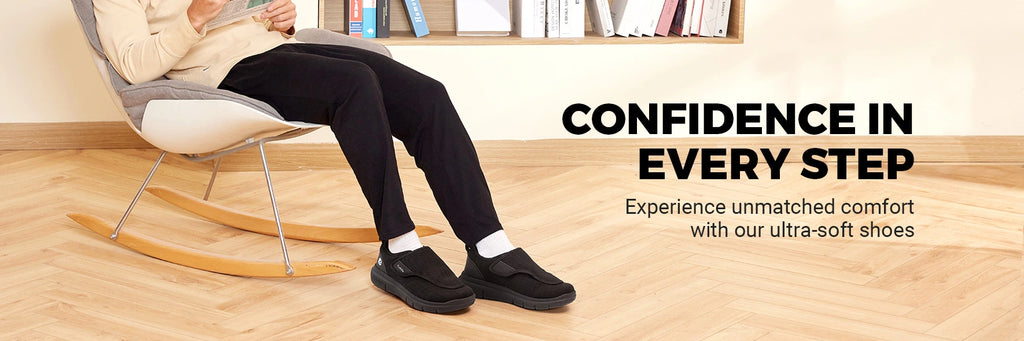
If you have ruled out the certified-SR-required scenario, or your workplace allows a well-cushioned walking shoe on the line, the FitVille Rebound Core V9 is built for exactly this kind of stand-in-place, hard-floor day. Here is how it maps to the cafeteria checklist:
- Cushioning for stand-in-place — a thick, responsive midsole made for hours on hard floors, not just for walking distance
- Grippy outsole for footing — a flexible rubber tread with a real contact pattern (this is everyday grip; it is not a certified slip-resistant rating)
- Secure locked heel — keeps the foot planted when you reach and pivot at the line
- Easy-clean upper — a wipeable surface for a job where spills are routine
- Standard, 2E, and 4E widths — true width options for feet that swell across a shift, with a roomy toe box
- Clean, neutral colorways — works with most institutional dress and uniform standards
To be clear on the honest line we drew above: the Rebound Core V9 has an everyday grippy outsole, not a certified slip-resistant rating. If your employer requires certified SR footwear, choose a certified shoe. If they do not, FitVille is the cushioning, width, and value alternative to the SR-brand collections.
See the FitVille lineup and find your width →
FAQ
What are the best shoes for cafeteria workers?
The best cafeteria shoes combine real all-day cushioning for standing in place, a grippy and flexible outsole for slick floors, a secure heel, and the correct width for feet that swell over a shift. If your employer requires certified slip-resistant footwear, start with a certified shoe; if not, a well-cushioned walking shoe like the FitVille Rebound Core V9 is a strong, value-friendly option.
What shoes are good for standing on a serving line all day?
Look for a thick, supportive midsole that cushions stand-in-place time on hard floors, plus a locked-in heel so the shoe does not shift as you reach across the line. Width matters too — a roomy toe box and a true 2E or 4E option keep your feet comfortable late in the shift.
Are slip-resistant shoes required in a cafeteria?
Often, yes. Many school, hospital, corporate, and university dining programs require certified slip-resistant footwear on the serving line because the floors get wet and greasy. Check your specific employer's policy — if certified SR is mandated, that requirement comes first, and you should choose a shoe that carries the certification your workplace specifies.
Why do my feet and legs hurt after a cafeteria shift?
It is the floor and the standing, not a mystery. Institutional kitchen and serving-line floors are hard and unforgiving, and hours of standing in one place lets your feet, legs, and lower back absorb all of it. A properly cushioned shoe acts as portable cushioning and spreads that load, which is why the right footwear makes the end of a shift feel different.
Cafeteria and food-service staff keep institutions running. The right shoe respects the work: cushioning for the standing, secure footing for the floor, and an honest answer about what it can and cannot do. Find your fit at FitVille →




