


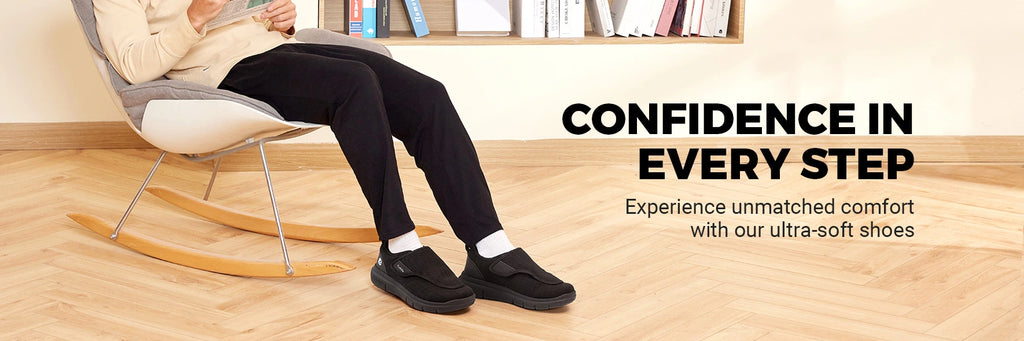
Standing Shoes for Women: Non-Work Daily Life Guide
Your shift is six hours of Thanksgiving prep, not a retail floor. It's a Saturday turning compost in the back beds, a Sunday hosting twelve people for brunch, a Tuesday spent helping your mother through appointments and pharmacy lines. Your feet do not know the difference. The load on the plantar fascia after six hours upright is the same whether you're working a register or working your own kitchen — but the shoe that solves it doesn't have to look like a uniform.
Most "best shoes for standing all day" articles assume you punched a clock to get there. This one is for the rest of us — women whose lives, not jobs, keep them on their feet — and what to wear when that's the reality of your week.
The 4-pick shortlist (if you only read this section)
For readers who want the answer up front, here are four women's shoes that hold up to long days of standing in non-work daily-life contexts, ranked by how well they balance standing-load engineering with everyday wearability.
| Pick | Best for | Width | Drop / stack | Approx. price |
|---|---|---|---|---|
| FitVille Rebound Core V9 Women's | All-day standing in lifestyle settings — cooking, hosting, SAHM days, caregiver duty | Standard, Wide (2E), Extra Wide (4E) | ~10mm drop, generous midsole stack | $79.99 |
| HOKA Bondi 9 Women's | Hard-floor hosting, long gardening sessions on uneven ground | B (standard), D (wide) | 4mm drop, max-cushion stack | $169.95 |
| Vionic Walker Classic Women's | Quiet-step caregiver days, errand chains | Medium, Wide | Moderate stack with built-in orthotic | ~$129.95 |
| Skechers GO WALK Arch Fit 2.0 Women's | Slip-on convenience for SAHM all-day, light hosting | Medium, Wide | Low-to-moderate stack, pillow-soft step-in | ~$89.95 |
The thread running through all four: enough midsole under the heel and forefoot to attenuate hours of vertical loading, an arch shape that actually meets your foot, and a forefoot that doesn't squeeze. Skip ahead to the section on standing comfort levers if you want to understand why those four traits, specifically.
Browse women's standing-friendly styles →
Standing load doesn't care about your job title
Biomechanically, "standing all day" is a posture, not a profession. When you're upright and roughly stationary for hours, your body weight loads the plantar fascia, the heel pad, and the metatarsal heads in a way that walking actually relieves. Walking redistributes pressure; standing concentrates it. After about ninety minutes the fascia is fatigued; after three hours the small muscles of the foot start to give; by hour six, most women feel it in the arches, the balls of the feet, and the lower back.
The retail clerk and the home cook are running the same biomechanical clock. The difference is everything around the standing:
- A retail worker stands on a flat sealed surface (concrete, polished vinyl) and walks short, repetitive routes.
- A weekend cook stands on hardwood or tile, pivots constantly between counter, stove, and sink, and reaches overhead repeatedly.
- A gardener stands on uneven dirt and lawn, kneels and rises, sometimes carries weight.
- A hostess stands on hardwood, walks short hops to refill, and is seen — her shoes are part of how she's dressed.
- A SAHM stands at counters, leans into cribs, paces hallways, and her shoes are on and off all day at the door.
- A caregiver daughter stands in waiting rooms, walks pharmacy aisles, and helps a parent in and out of cars.
The shoe needs to solve the same biomechanical load — but it also needs to fit the life. That's why "best work shoes for standing" lists frequently miss this reader: they recommend slip-resistant kitchen clogs and chunky uniform-coded sneakers that look out of place at a brunch table or a school pickup.
The standing comfort levers (what actually matters)
Strip away the marketing language and there are six things that determine whether a shoe will carry you through a six-hour day on your feet.
1. Midsole stack and density
Stack is how thick the foam is between your foot and the ground. Density is how firm that foam is. For long standing, you want more stack than you'd want for, say, sprinting — usually 25–35mm under the heel — and a density that compresses just enough to spread peak pressure without bottoming out. Too soft and your foot sinks and the arch fatigues; too firm and you feel every minute.
2. Arch shape match to your foot
This is the part most "standing shoe" rankings get wrong. There is no single best arch height. A shoe with an aggressive arch contour can be torture on a low-arched foot and a revelation on a high-arched one. When you try a shoe, the arch should feel like a hand cupping your foot, not a knuckle pressing into it. If you feel anything sharp or insistent under the arch in the first sixty seconds, it will be louder by hour two.
3. Deep heel cup
A deep, structured heel cup holds the fat pad of your heel directly under the calcaneus where it belongs. When the heel pad migrates outward (which is what happens in a shallow or worn-out heel cup), the bone effectively loses its built-in cushion and you feel impact through the rear of the foot for the whole day.
4. Wide forefoot — actually wide
After three to four hours of standing, the forefoot swells and the metatarsal heads splay slightly. A shoe that fits perfectly at hour one will feel like a vise at hour five if the forefoot is narrow. A wide toe box gives the foot somewhere to expand and lets your toes settle into a natural toe splay rather than being stacked on top of each other. Look for shoes available in 2E or 4E widths, not just "wide" as a single bucket.
5. Weight
A heavy shoe is fine if you're walking; for static standing it's surprisingly draining. Each leg lift to pivot, reach, or step adds up. For women's standing shoes, aim under about 9.5 ounces per shoe in your size. The HOKA Bondi 9 runs heavier because of its stack — worth it on uneven ground, less ideal on a polished hardwood floor where lighter feels better.
6. Shock-attenuating outsole
The outsole rubber and its lug pattern determine how much vibration travels up from a hard surface. A blown-rubber outsole with a moderate tread softens hardwood and tile noticeably. A racing-flat-style thin outsole transmits everything.
Match the shoe to the scenario, not the job
Here is the practical part. Use the scenario you're actually in to choose the shoe.
Cooking — Thanksgiving prep, holiday baking, the weekly meal-prep marathon
You want closed-toe (dropped knives, hot oil), grease-resilient uppers you can wipe down, and enough midsole stack to survive six hours on tile. A canvas upper is a mistake — it absorbs splatter. A mesh upper is fine if it's dense; loose engineered mesh will hold odors. A leather or coated knit upper cleans best.
Gardening — half-day yard work, raised-bed planting, mulching
This is the dirtiest standing scenario, and most "comfort shoes" are not built for it. You want a washable upper (machine or hose), light tread (you're not hiking — too aggressive a lug just packs with dirt), and a shoe whose insole can be pulled and dried overnight. Avoid premium leather. A synthetic mesh or knit upper with a removable footbed is ideal.
Hosting and entertaining — brunch for twelve, holiday open house
The shoe is part of how you're dressed. Black, cream, blush, or muted neutrals read as outfit rather than gear. A soft-soled walking shoe in a non-athletic colorway is more presentable than you'd guess — guests look at faces, not feet, but uniform-coded white-toe sneakers do break a polished look. Soft sole matters here because you'll be on hardwood and you want your steps to be quiet for the room.
SAHM all-day — school runs, grocery hauls, the 5pm witching hour
The dominant factor is on-off frequency. You're at the door six to twelve times a day. A slip-on or laceless step-in saves real minutes and frustration. Machine-washable matters — toddler-adjacent shoes need to go in the wash. Look for a shoe you can wear with leggings and with a casual dress for school pickup.
Volunteering and community — church serving, school events, food bank shifts
A non-uniform standing shoe in a subtle color signals "I belong here as a person, not a worker." Avoid bright safety colors and obvious athletic branding. Many readers in this scenario specifically want to not look like they're in work mode.
Caregiver duty — pharmacy lines, doctor's offices, helping a parent
Long stretches of slow, quiet steps. You want the lightest standing-capable shoe you can find, with a sole that doesn't squeak on polished hospital floors, and an upper that breathes (waiting rooms run warm). Slip-on is helpful when you're constantly in and out of cars.
How to test a standing shoe before you commit
If you can try shoes in-store, do this thirty-minute test (most "10-minute walk around the store" tests miss the failure modes of long standing).
- Lace up both shoes and stand still for two full minutes. Not walking. Standing. Pay attention to where pressure accumulates. If the arch is loud at minute two, walk away.
- Move to a hard surface — tile or hardwood, not carpet. Carpeted store floors flatter every shoe. Find an entryway or a checkout area with hard flooring.
- Stand there for another fifteen minutes. Window-shop. Read your phone. Do not pace. This is the closest you can get to the actual load you'll experience at home.
- At minute twenty, check the forefoot. Swelling kicks in around here. If the forefoot feels tight, the shoe is too narrow for your standing reality, even if it fit at minute one.
- Walk a short loop and stop. A standing shoe should feel as good stopped as it does moving. If it feels great walking but you want to sit down the second you stop, it's a walking shoe, not a standing one.
At home, give a new shoe a full one-week trial on your real schedule before deciding. The first day will lie to you; day three is honest.
Where FitVille Rebound Core V9 fits
The FitVille Rebound Core V9 Women's was engineered around the same standing-load problem this article describes, but in a form factor that doesn't look like work uniform. Three details are worth flagging because they map directly to the six comfort levers above.
- Wide toe box — available in standard, Wide (2E), and Extra Wide (4E) widths. This addresses the forefoot-swelling problem at hour three to five of standing, when most narrower shoes start to bite.
- Ergonomic arch support — contoured rather than aggressively domed. Most readers who've struggled with shoes that "stab" the arch find this profile noticeably more forgiving over a long day.
- Shock-absorbing midsole — enough stack under the heel and forefoot to attenuate vertical loading on tile and hardwood, without going so soft that the foot sinks and the arch fatigues.
The Rebound Core V9 comes in lifestyle colorways — soft neutrals and muted tones that read as everyday wear rather than work uniform — which is the whole point for the reader this guide was written for. At $79.99 it's also the most accessible price point in the four-pick shortlist.
Use code AFS25 for 25% off sitewide.
Shop the Rebound Core V9 Women's →
Common mistakes when buying standing shoes for non-work life
- Buying a slip-resistant work shoe because the listicle said so. Kitchen-line slip-resistant rubber is engineered for grease on commercial flooring. On a home hardwood floor it can actually feel grippier than you want, which makes pivoting in place feel sticky.
- Buying a running shoe and calling it a standing shoe. Running shoes are tuned for a heel-strike-to-toe-off cycle that's repeating every half-second. Static standing loads them in a way they're not designed for, and you'll often feel a thinner shoe with a wider forefoot serves you better than a maximalist running stack.
- Buying the same shoe in your usual size. Standing shoes need to fit your day-three foot, not your fresh-morning foot. Many women size up a half-size or move from standard to Wide for standing-heavy use.
- Replacing too late. A midsole compressed flat from a year of long days has lost the property that made the shoe work. If a shoe that used to feel great now feels like nothing, the foam is done.
FAQ
What shoes are best for standing all day at home?
A women's walking shoe with a generous midsole stack, a deep heel cup, a wide toe box, and a soft outsole that handles hardwood and tile well. The four picks at the top of this article — FitVille Rebound Core V9, HOKA Bondi 9, Vionic Walker Classic, and Skechers GO WALK Arch Fit 2.0 — are all suited to home standing. Match the specific shoe to your dominant scenario (cooking, hosting, SAHM, gardening) using the section above.
Can I wear running shoes for standing?
You can, but they're not optimized for it. Running shoes are tuned for repeated heel-to-toe motion and tend to have narrower forefoots than is ideal for hours of static standing, when the forefoot swells. A walking shoe or dedicated standing-capable lifestyle shoe usually feels better at hour four onward.
What's the difference between work standing shoes and lifestyle standing shoes?
Work standing shoes prioritize slip resistance, oil resistance, sometimes safety toes, and a uniform-friendly look (usually black). Lifestyle standing shoes prioritize the same biomechanical support — arch, heel cup, forefoot width, midsole stack — without the slip-resistant rubber, the safety hardware, or the uniform aesthetic. The foot under the shoe is doing the same work; the shoe just looks like it belongs at a brunch instead of behind a counter.
How often should I replace shoes I wear for long standing?
Most women's standing-use shoes lose their best-day cushioning between 300 and 500 hours of wear. If you're standing in them three to four hours a day, that's roughly four to six months of heavy use. The clearest signal is feel: when a shoe that used to relieve foot fatigue now seems neutral or starts producing fatigue itself, the midsole has compressed. Don't wait for the upper to fail — the foam dies first.
Are slip-on shoes okay for long standing, or do I need laces?
Slip-on can be fine for long standing as long as the heel cup holds the foot in place. A shoe that slides at the heel forces small toe-clench corrections all day, which is genuinely tiring. If you prefer slip-on for SAHM convenience or quick errands, prioritize models with a structured, deep heel cup and a snug throat.
My feet hurt after three hours even in "comfort" shoes. What now?
Three culprits, in order: the arch shape doesn't match your foot (this is the most common), the forefoot is too narrow for your day-three swelling, or the midsole has already compressed and you're past the shoe's useful life. Try the thirty-minute in-store test above with a different arch profile and one width up from your usual.
A closing note
You did not choose to be on your feet all day; your life chose for you. The reward for showing up for it shouldn't be aching arches by hour four. The shoe you wear for a six-hour Thanksgiving prep or a half-day in the garden can do the same biomechanical work as a kitchen-line clog without looking like one. Pick the scenario, match the shoe to it, and give yourself permission to replace it when the foam is done.
Use code AFS25 for 25% off sitewide.
Browse women's standing-friendly styles →
References
- FitVille Rebound Core V9 Women's product page. FitVille
- HOKA Bondi 9 Women's product specifications. HOKA
- Vionic Walker Classic Women's product page. Vionic Shoes
- Skechers GO WALK Arch Fit 2.0 Women's product page. Skechers
- American Podiatric Medical Association — foot health and footwear guidance. APMA
- OSHA ergonomics guidance on prolonged standing. OSHA




