


What Shoes Fit Over an AFO Brace in the UK?
Shoes that fit over an AFO usually have extra width and depth, a removable liner, a low opening and laces or adjustable straps. The right size cannot be chosen from a label alone: take the exact AFO, socks and any approved insert when you try shoes, then check the whole brace-and-shoe combination with your orthotist.
Fit around the device, not just the foot
An ankle-foot orthosis adds girth, depth and sometimes length inside the shoe. Its heel also needs to sit fully down and back. Guy's and St Thomas' advises footwear that is wide and deep enough, fastens with laces or straps and allows the original insole to be removed for space.
| Useful feature | What it changes |
|---|---|
| Removable liner | Releases depth without adding unnecessary length |
| Low-opening tongue | Lets the braced foot enter with less force |
| Laces or adjustable straps | Holds the shoe securely around added volume |
| Broad stable outsole | Supports the wider brace-and-foot base |
| Low heel geometry | Avoids changing the AFO angle unexpectedly |
Slip-ons, shallow shoes and high heels are usually poor matches because they either cannot accept the brace or fail to retain it securely.
Do not size up by guesswork
Some NHS services note that an AFO may require one or more sizes above the unbraced foot, but that is a starting point, not a universal rule. Excess length can move the break point of the shoe, create toe clearance problems and let the heel slide. Try several sizes and shapes with the device fitted correctly.
If you wear an AFO on one side only, the two feet may need different shoe sizes or a fit adjustment. Ask your orthotist whether split sizing, an insole for the other shoe or specialist footwear is appropriate.
Compare adjustable wide options carefully
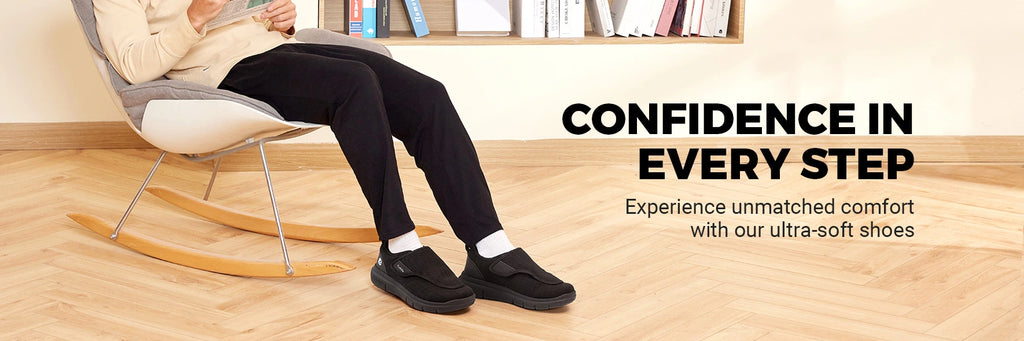
The FitVille EasyTop Wings V2 lists 2E, 4E and 6E widths plus an adjustable strap and high instep. Those features can make it a candidate to test, but the product is not guaranteed to fit every AFO. Brace shape, soleplate length and required heel angle still decide.
The FitVille Women's Rebound Core V9 uses a more conventional trainer structure with 2E and 4E widths. That may suit some lower-volume orthoses, while a bulkier AFO may need a wider-opening design. Verify fit rather than assuming that an extra-wide label is enough.
Check the skin and brace position
Wear the AFO according to the schedule from your orthotist. After removing it, inspect the skin. Guy's and St Thomas' advises contacting the orthotics service if redness lasts longer than 30 minutes or if there are sores, blisters, pain, irritation or increased rubbing.
Make sure the shoe does not bend or twist the brace, lift the heel out of its seat or press a strap edge into the skin. Never cut, file or reshape the AFO yourself to make a shoe fit.
FAQ
Can I wear normal trainers over an AFO?
Sometimes, if they provide sufficient internal depth, opening and retention after the liner is removed. Take the AFO to the fitting and ask your orthotist when the combination is uncertain.
Should I remove the shoe's original insole?
Often yes, because it creates useful depth, but follow device-specific advice. Do not remove built-in components or alter the AFO without approval.
Bottom line
The best AFO footwear accommodates the exact device without distortion, holds the heel securely and preserves the angle your orthotist intended. Fit the complete system and monitor the skin.
Shop Fresh Picks and use code AFS25 for 25% OFF sitewide
Next read
References
- AFO fitting, footwear selection and skin-check guidance. Guy's and St Thomas' NHS Foundation Trust
- Footwear features for accommodating an AFO. Royal National Orthopaedic Hospital
- FitVille EasyTop Wings V2 product specifications. FitVille
- FitVille Women's Rebound Core V9 product specifications. FitVille




