


Best Shoes for Welders & Metal Fabricators 2026
On the torch, your boots are non-negotiable. Certified safety-toe, heat-resistant, built to stand up to sparks and slag — that's the only footwear that belongs in the weld zone. This guide is about the other 14 hours: the commute, the break room, the drive home, the errands after, and the shoe your wrecked feet deserve the second the boots come off.
So let's be clear from the first line. This article is split in two. On the clock, you wear certified welding boots — full stop. Off the clock, you have a different problem entirely: feet that have been crushed and standing all day in heavy steel-toe leather, and nothing comfortable to change into. That second problem is where FitVille fits. The first one isn't ours to solve, and we'd never pretend otherwise.
On the clock: what welding footwear actually requires
Welding and metal fabrication put your feet near hazards almost no other trade faces all at once: sparks, slag, molten spatter, hot metal, heavy stock, and grinding debris. Protective footwear for this work is not a comfort upgrade — it's mandated PPE, and it has a real spec:
- Certified safety toe (ASTM F2413 in the US, or your region's equivalent) to protect against dropped stock and heavy material
- Metatarsal guards on many fab-shop jobs, protecting the top of the foot from falling metal and spatter
- Heat- and spark-resistant all-leather uppers — leather resists ignition and sheds spatter; synthetics and foam do not
- Non-melt construction throughout, including outsoles rated for heat
- No exposed mesh or foam anywhere near molten metal — those materials can catch a spark, melt, or ignite
A mesh-and-foam walking shoe fails every one of those requirements. Near sparks, slag, and molten spatter, it isn't just unsuitable — it's unsafe. We want to be completely plain about that: do not wear a casual comfort shoe in the weld zone. Not for "just a quick tack," not when the shop is slow. The wrong tool here doesn't mean sore feet; it means a burn, a melt, or worse.
If you're checking what your job actually requires, the answer is a certified welding boot. Red Wing, Timberland PRO, KEEN Utility, Thorogood, and Ariat all build boots made for exactly this — heat-rated, safety-toe, often met-guard, all-leather. They make the footwear you need on the job. FitVille is not a welding boot, is not a safety-toe shoe, and is not a substitute for one. For the on-the-clock side, route to a proper protective boot and don't compromise.
Welder vs. electrician vs. mechanic: the heaviest PPE line in the trades
If you've read our guides for the trades, you'll notice welding draws the hardest line of all. An electrician needs electrical-hazard-rated protection and a foot that stays planted on ladders and in panels. An auto mechanic needs grip on oily floors, toe protection, and something that wipes clean. Both are demanding. Both still mean certified work footwear on the job.
Welding stacks something on top of all of that: heat, sparks, slag, and molten spatter. That's what makes welding footwear the most demanding of the set — and it's exactly why a mesh/foam shoe that might survive a parts bay is genuinely dangerous next to an arc. Same family of advice — right tool for the right moment — but welding has the least room for shortcuts.
So the rule for the weld zone is simple: certified welding boots, every shift, no exceptions. With that settled, let's talk about everything that happens after you clock out.
Off the clock: the other side of a welder's day
Here's the part nobody makes a shoe for. You finish a 10-hour shift standing on concrete in heavy, stiff, steel-toe leather. Your feet are swollen. Your arches are done. Your lower back has been bracing all day. Then you peel off the boots — and your only option is to either keep them on for the drive home or jam your tired feet into whatever's by the door.
That post-shift wreckage is occupational, not medical. It's what heavy boots plus all-day standing on hard floors do to anyone's feet and back. (If pain is sharp, lingers, or doesn't ease with rest, that's a conversation for a clinician — not something any shoe should claim to fix.) What it does call for is an honest comfort shoe waiting for the moment the boots come off.
That's the moment FitVille is built for:
- The commute and the drive home, when you just want your feet out of the boots
- The break room and lunch, when you've got 30 minutes off the floor and want to actually rest
- Errands after work — the parts store, the grocery run, the kid's pickup
- Recovery on a day off, when your feet are still paying for the week
None of that is welding. None of it is the weld zone. It's the rest of your life around the job — and that's exactly where a cushioned, wide, easy-on comfort shoe earns its place.
What to look for in an off-shift comfort shoe
After a boot shift, your feet aren't the shape they were at 6 a.m. They're swollen, tender, and tired. The off-shift shoe should meet them where they are:
| Feature | Why it matters after a boot shift |
|---|---|
| Real cushioning on a stable base | Takes the edge off concrete-fatigued feet without feeling tippy |
| True width options (standard / 2E / 4E) | Feet swell across a shift; width is relief, not a luxury |
| Roomy toe box | Lets crushed toes spread out after hours of stiff leather |
| Easy-on, secure fit | When your feet are wrecked, you don't want to fight laces |
| Durable, easy-care upper | It's still going to ride around in a work truck |
Notice what's not on that list: a safety toe, heat resistance, or spark protection. Those belong to your welding boots. An off-shift shoe is a comfort tool for when you're out of the weld zone — and trying to make one shoe do both jobs is how people end up under-protected at work and uncomfortable after it.
The off-shift comfort shoe: FitVille Rebound Core V9
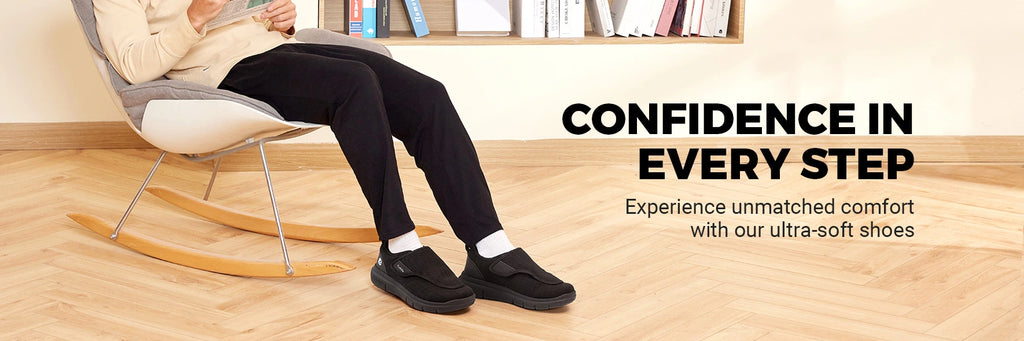
The FitVille Rebound Core V9 is built for that boots-are-off moment — strictly off the clock, never in the weld zone:
- Cushioning for tired post-shift feet — soft enough to feel like relief after concrete, stable enough to actually walk on
- Easy-on, secure fit so you're not wrestling laces with wrecked feet at the end of a shift
- Standard / 2E / 4E widths with a roomy toe box, built for feet that have swollen all day
- Durable casual colorways (black, brown, neutral grey) that look right for the commute, errands, or a day off
To be completely clear one more time: the Rebound Core V9 is a casual comfort shoe. It is not a welding boot, has no safety toe, and is not for any on-the-job welding or fabrication work. Wear your certified boots on the clock. Wear this when they come off.
Find your off-shift comfort shoe →
Where welders fit in the on-feet-professions set
Welding sits in a wide family of jobs that wreck your feet for a living — electricians, auto mechanics, house painters, warehouse crews, and everyone else who stands all day on hard floors. The shared thread isn't the work shoe; that's specific to each trade's hazards. The shared thread is what comes after: an honest, comfortable shoe for the off-clock hours. If you're on your feet all day for work, the off-shift recovery shoe is the same idea no matter which trade you're in. (See our recovery-shoe guide for more on that after-shift idea.)
Frequently asked questions
Do welders need safety-toe boots?
Yes — plainly, yes. On the job, welders and metal fabricators are required to wear certified protective footwear: a safety toe (ASTM F2413 or your region's equivalent), often metatarsal guards, heat- and spark-resistant all-leather uppers, and non-melt construction. Route to a proper certified welding boot for on-the-clock work. A casual comfort shoe is not a substitute and does not belong in the weld zone.
Can I wear walking shoes for welding?
No — not in the weld zone. A mesh or foam walking shoe has no safety toe, no heat or spark resistance, and exposed materials that can melt or ignite near molten metal. It's unsafe around sparks, slag, and spatter. On the job, wear certified welding boots. Save the comfort shoe for the commute, the break room, and after the boots come off.
What's a good comfortable shoe for after a welding shift?
Look for real cushioning on a stable base, true width options (standard / 2E / 4E), a roomy toe box for feet that have swollen all day, and an easy-on, secure fit so you're not fighting laces with tired feet. The FitVille Rebound Core V9 is built around exactly that — strictly as an off-the-clock comfort shoe, never as work footwear.
Why are my feet wrecked after a shift in welding boots?
It's occupational, not a diagnosis. Heavy, stiff steel-toe boots plus a full shift standing on concrete add up to swollen, tired feet and a tired lower back — that's what the job does to anyone's feet. A cushioned, wide, easy-on shoe to change into can make the off-clock hours a lot more comfortable. If pain is sharp, lingers, or doesn't ease with rest, see a clinician rather than relying on any shoe.
On the torch, your boots are the law — certified, heat-rated, safety-toe, no exceptions. But the second they come off, your feet have earned something better than the floor mat by the door. Keep the welding boots for the weld zone, and give the rest of your day the comfort it's owed. Shop off-shift comfort shoes at FitVille →




