


Postpartum Comfort Shoes for New Moms (2026 Guide)
Your body's not the only thing that changed. A widely cited body of foot-research suggests that roughly sixty to seventy percent of women wear a different shoe size after a first pregnancy — and most postpartum-essentials lists skip this entirely.
This guide is for new moms in the first twelve months postpartum, and for third-trimester readers who want to know what to plan for. It's not about recovery. It's about shoes that fit the body you're standing in now.
Scope, plainly stated. FitVille is not a medical postpartum-recovery brand. This guide addresses shoe accommodation for everyday postpartum life. For recovery questions — anything to do with healing, pelvic floor, abdominal separation, bleeding, pain, or how your body is or isn't bouncing back — please consult your healthcare provider.
Browse comfort shoes that fit the new-mom day →
What shoes are best for new moms after pregnancy?
The short answer: a shoe that accommodates a foot that has often grown a half to a full US size, cushions the all-day standing load of carrying an infant, and slips on with one hand while the other hand is full. Most pre-pregnancy shoes meet none of those three at once. The shift is functional, not cosmetic — your feet are doing a different job now, and the shoe needs to match.
Three things postpartum changes about shoes
Postpartum shoe-fit problems usually come down to three concrete shifts. Naming them helps you shop on purpose instead of cycling through pairs that almost work.
Shift 1: Your feet are probably bigger — and may stay that way
Pregnancy weight, hormone-driven ligament softening (relaxin), and a flattening of the medial arch combine to lengthen and widen the foot. Foot-research over the last decade has found that a sizeable majority of women — often cited around sixty to seventy percent — measure a different shoe size after a first pregnancy, with a typical increase of about half a US size to a full size. For many women, this change persists past the first year. It is not universal, and it is not a guarantee — but it is common enough that if your pre-pregnancy shoes feel tight at the toes, across the ball of the foot, or at the widest point, the problem is probably the shoe, not your imagination.
Shift 2: The standing load is different now
A seven-to-fifteen-pound infant carried four-to-six hours a day — across the kitchen, around the living room, on a stroller-walk, swaying to settle — shifts plantar pressure forward and slightly side-to-side. Your old shoes were sized and cushioned for a body that wasn't constantly holding fifteen extra pounds at chest level. The right shoe should cushion and support that load through the midsole and the arch — not treat it, not correct it, just match it. A shoe that felt fine on a pre-baby commute can feel surprisingly tired by hour three of pacing the hallway.
Shift 3: Slip-on convenience stops being optional
There's a category of footwear advice that assumes you have two hands, ninety seconds, and a place to sit. New moms often have none of those. You're bending over a stroller buckle with a baby on one hip. You're heading to the door because someone needs to be picked up, fed, or rescued from the dog's water bowl, and you have about eleven seconds. Pull-on shoes, one-step closures, low or no laces — these stop being a style preference and start being basic logistics. A shoe you can't get on with one hand is a shoe you'll stop wearing.
How to check if your shoe size actually changed
Around six to twelve weeks postpartum, when the most dramatic swelling has typically settled but the foot has had time to take its post-pregnancy shape, do a quick at-home measurement.
- Wait until late afternoon or evening — feet are at their largest end of day.
- Stand barefoot on a piece of paper, weight evenly distributed.
- Have someone trace each foot with a pencil held vertically against the skin (or do it yourself, slowly).
- Measure heel to longest toe in centimeters and inches.
- Measure the widest point across the ball of the foot.
- Do both feet — postpartum size asymmetry is common, and you should fit the larger foot.
Compare against a shoe-size chart for the brands you wear. If the longer foot now reads a half-size or full size up from your pre-pregnancy number, that matches what most postpartum foot research describes. If the width measurement has gone up but the length is similar, you may need a wide width (often labeled D or 2E in women's) in the same number you've always worn.
Sidebar — Talk to your provider, not the internet, about recovery. This article is about shoe fit. If you have questions about how your body is healing — pelvic-floor symptoms, abdominal separation, pain anywhere in the lower body, prolonged swelling, or anything else that feels off — please talk to your OB, midwife, or a pelvic-floor physical therapist. A shoe can fit you well. It cannot answer those questions, and we won't try to.
Shop wide-width comfort shoes for the new-mom day →
The baby-carry standing load, in shoe terms
Most footwear is built around an assumed gait — walking, jogging, standing, dressy. "Carrying a baby for hours on hard floors" isn't on that list, but it's most of the day for a lot of new moms. A few practical notes on what that load actually does to a shoe:
- Forefoot cushioning matters more than usual. Holding weight at chest level shifts the body's center of mass forward, loading the ball of the foot. A shoe with a soft, shock-absorbing midsole takes more of that load than a thin, flat sole will.
- Arch support matters more than usual. A flattened, fatigued arch under constant load is the body asking for help that bare feet on hardwood can't give it. An ergonomically shaped footbed with real arch contact distributes the load across the foot instead of concentrating it.
- Heel-to-toe stability matters more than usual. When you're swaying with a baby, micro-adjusting balance constantly, a shoe with a stable platform and a low, grounded heel does less work fighting you. Tall heels and unstable lifestyle sneakers add fatigue you don't notice until you sit down.
None of this is medical. It's the difference between a shoe that gets out of the way of your day and a shoe that becomes one more thing that hurts.
The slip-on convenience reality
A short, honest list of moments when laces don't work:
- One hand on the baby, the other on the stroller, ten seconds until the rideshare pulls up.
- Three a.m., feeding cluster, half-awake, kitchen-cold floor.
- Diaper-bag-on-shoulder, car-seat-in-hand, side-door-of-the-car balance.
- The doorbell, the dog, and the package delivery driver at the same time.
- Anything involving stairs while holding a baby.
A pull-on shoe with a flexible collar, a stretch-knit upper, or a single-pull closure handles all of those. Traditional lace-ups don't. This is the shift most new moms feel first — and it's the one that pre-baby shoe shopping rarely accounts for.
What FitVille Rebound Core V9 brings to the new-mom day
This isn't a recovery product, and we're not going to pretend it is. The Rebound Core V9 is a wide-default comfort walking shoe, and its design happens to map cleanly onto the three postpartum shifts above.
- Wide-width as the default fit. Standard sizing runs accommodating, with wide (2E) and extra-wide (4E) options across many sizes — useful when your foot has measured up half a size and a width.
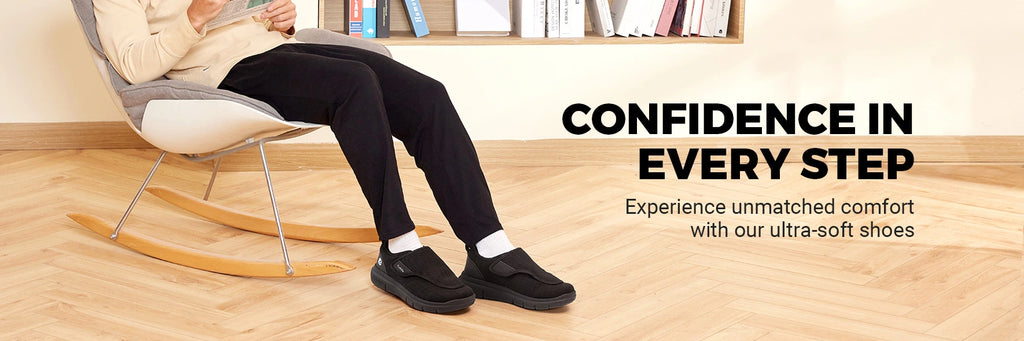
- Slip-on-friendly options across the line. Several Rebound Core V9 styles use stretch collars or one-step closures, so the shoe goes on with one hand and a knee-bend.
- Machine-washable uppers. Spit-up is a fact of postpartum life. So is sweet-potato puree, leaked-formula puddles, and the mystery substance on the kitchen floor. A washable upper means the shoe survives the year.
- Ergonomic arch support. A contoured footbed gives the arch contact it wants under the all-day baby-carry standing load, instead of letting it collapse onto a flat insole.
- Shock-absorbing midsole. The Rebound Core midsole cushions the walking-to-soothe routine on hardwood, tile, and laminate — the surfaces new moms pace for hours that running shoes were never tuned for.
You'll see plenty of postpartum-essentials lists recommend Vionic, Naturalizer, or Allbirds slip-ons in this slot, and they're reasonable picks. Where FitVille fits is on width: 2E and 4E availability as a baseline, not an afterthought. If your post-pregnancy foot measured wider as well as longer, that matters.
See the latest FitVille comfort picks →
If you're still pregnant: what to plan for
If you're third trimester and reading this ahead of time, two practical notes:
- Don't pre-buy your postpartum shoes by size. Your feet may not settle into their final shape until six to twelve weeks after delivery. Buy when you can measure, not now.
- Do think about category. A slip-on, wide-friendly, cushioned shoe is a reasonable thing to have in mind. Brand and exact size can wait. If you already wear a wide width, lean wider for the postpartum pair.
A surprising number of new moms try to power through the first three months in pre-pregnancy shoes that no longer fit, because buying new shoes feels like a low-priority spend. Foot pain on top of sleep deprivation is its own kind of misery — give yourself permission to budget for one pair that actually fits.
Returning to work: the shoe rotation
Many new moms return to paid work between six and twelve weeks postpartum, sometimes later, sometimes earlier. The shoes you wore to that job before are not necessarily the shoes you can wear now. Two notes:
- Re-measure before you assume. Your office shoes may have been fine pre-pregnancy and be visibly too narrow now. Measure first, shop second.
- Build a small rotation. A pair of comfort walking shoes for commute and standing time, a softer slip-on for desk-or-floor moments, and one dressier option for meeting days — three pairs, all sized to your postpartum foot, handles most workweeks.
You don't need a closet overhaul. You need shoes that fit the foot you have now.
A note on what this guide doesn't try to do
To be plainly useful, we have to also be plainly clear about what we're not:
- We are not a postpartum-recovery resource. We don't make claims about pelvic-floor support, abdominal separation, healing timelines, or postpartum exercise.
- We don't make breastfeeding or lactation claims of any kind — footwear has nothing to do with that.
- FitVille shoes are not maternity medical devices, not postpartum belts, not recovery garments. They're comfort walking shoes, sized in a way that happens to fit a lot of postpartum feet.
For anything in the first list, talk to your OB, midwife, pelvic-floor physical therapist, or pediatrician as appropriate. Those are the right people, and we are not those people.
FAQ
Do my feet permanently change after pregnancy?
Often, yes. A widely cited body of foot research has found that the majority of women — frequently cited around sixty to seventy percent — measure a different shoe size after a first pregnancy, with a typical increase of about half a US size to a full size, often driven by a flattening of the medial arch. For many women, the change persists past the first year and into subsequent pregnancies. Not universal, but common.
What shoes are best for carrying a baby all day?
A wide-fit, cushioned walking shoe with real arch support, a shock-absorbing midsole, and a stable, low heel handles the all-day baby-carry standing load better than thin-soled lifestyle sneakers or flat ballet styles. Slip-on or one-step closures help when your hands are full. Look for wide-width availability if your post-pregnancy foot has measured up.
Why don't my old shoes fit after having a baby?
Pregnancy weight, hormonal ligament loosening, and a flattening of the arch typically lengthen and widen the foot. A shoe that fit pre-pregnancy can now feel tight at the toes, across the ball of the foot, or at the widest point — because the foot inside it is measurably different. The shoe didn't shrink; the foot grew.
What shoes are good for walking the baby for hours?
For long stroller-walks or pacing-to-soothe sessions, prioritize a cushioned midsole, ergonomic arch support, a stable platform with a low heel, and width that doesn't squeeze. Slip-on convenience matters when you're heading out the door fast. A wide-default comfort walking shoe — FitVille's Rebound Core V9 is one option, alongside Vionic, Naturalizer, and similar comfort-walking lines — handles this load better than running shoes or fashion sneakers.
References
- American College of Obstetricians and Gynecologists, patient resources on the postpartum period. ACOG
- Segal NA et al., research on pregnancy-related changes in foot structure. PubMed summary
- FitVille Rebound Core V9 product page. FitVille
- FitVille comfort-footwear collection. FitVille Fresh Picks
This guide addresses shoe accommodation for everyday postpartum life. It is not medical advice. For recovery questions, please consult your OB, midwife, or pelvic-floor physical therapist.




