


Best Men's Walking Shoes for Europe 2026
You know the moment. Day three in Rome, the Forum behind you, dinner reservation in Trastevere in twenty minutes, and your right pinky toe is beginning a slow protest. The shoes that felt fine on the airport carpet are now the only thing you can think about. This is the trip-defining decision most men make in fifteen panicked minutes at REI the night before they fly — and it is the wrong way to do it.
European walking is not American walking. The pavement is older, the daily mileage is higher, the dress code at dinner is sharper, and the weather changes between lunch and aperitivo. The shoes that work for a Saturday at Costco do not necessarily work for ten days of granite setts, marble, gravel, and the occasional Michelin-adjacent osteria. This guide is for men who want to pack one or two pairs, walk 15,000 to 25,000 steps a day, and not look like they wandered out of a 5K race.
What Europe actually demands from a walking shoe
Most travel-blog round-ups pretend Europe is a uniform surface. It is not. A real walking rubric for a Paris-Rome-Amsterdam-Barcelona corridor needs to handle four things at once.
- Cobblestones and setts. Rome's sampietrini, Prague's mosaic limestone, Lisbon's calçada, and the worn granite of every Old Town in northern Europe. These surfaces tilt your foot at angles your home sidewalk never does. A flat, soft outsole rolls; a stiff, lugged outsole grips. Stack height matters too — a tall, narrow midsole can feel tippy on uneven stones.
- Mixed precipitation. Paris drizzle. Amsterdam horizontal rain. Surprise August thunderstorms in Florence. You either need a water-resistant upper or a quick-drying mesh you can live in for an hour while it dries.
- 12,000 to 25,000 steps a day. That is a marathon's worth of standing and pivoting spread across museums, restaurants, and trains. Cushioning matters, but so does midsole resilience — soft foam that bottoms out by hour eight is worse than firmer foam that holds.
- Social-context dressing. Europeans do not wear chunky white running shoes to dinner. They will not throw you out, but you will feel it. A low-profile silhouette in a muted color blends in across cafés, wine bars, and most restaurants short of black-tie.
The shoe that wins is the one that does all four passably — not the one that wins any single category.
The packing question: one pair, or one + one?
There are two defensible strategies. Both work; pick based on luggage discipline.
Strategy A — One walking shoe, one dressier shoe. A low-profile walking sneaker for daytime, plus a leather derby, suede chukka, or minimalist sneaker for dinner. Total weight in your carry-on: roughly 1.5 kg. Best for trips with reservations, opera, or any context where you would feel underdressed in performance footwear.
Strategy B — One all-in-one shoe. A single pair that walks 20K steps and still looks acceptable in a wine bar. This is harder to pull off, but a clean leather or knit walking shoe in black, brown, or charcoal can do it. Best for backpackers, business travelers compressing into a carry-on, or anyone who genuinely hates packing.
Whichever you choose, do not pack a shoe you have not walked in for at least 30 miles at home. The single most common Europe mistake is the brand-new pair on day one. New foam, new upper, untested width — that is how blisters become trip-ruining infections. Break-in is not optional.
Five features that actually matter
| Feature | Why it matters in Europe |
|---|---|
| Outsole grip pattern | Cobblestones are uneven and often wet. Multi-directional lugs or siping outperform smooth treads on granite and marble. |
| Stack height under 35 mm | Lower stacks feel more stable on tilted stones; max-cushion towers can feel wobbly on uneven surfaces. |
| 2E or 4E width option | Long flights swell feet 5–10%. A standard-width shoe that fit at gate B17 may be a vise by day two in Florence. |
| Water-resistant or fast-drying upper | Goretex, treated leather, or open mesh that dries in two hours. Avoid dense knit that holds water all afternoon. |
| Low-profile silhouette | Slim midsole, muted color, no aggressive logos. Blends into a café table without effort. |
A wide toe box matters more than most travelers realize. Toes that have nowhere to spread on hour ten become hot spots on hour eleven.
The 2026 brand landscape
Here is how the major contenders actually stack up for a Europe trip — not for marathon training, not for nursing shifts, for ten days of mixed walking.
HOKA — Maximum cushioning, recognizable silhouette. The HOKA Clifton 9 and HOKA Bondi 9 carry you through 25K-step days better than almost anything else, but the chunky midsole reads "athletic" in social settings and the stack height can feel tippy on cobbles. Best for men who prioritize comfort over silhouette.
On — Sleeker profile, Swiss design language that passes in European cafés. The On Cloud 5 and On Cloudgo are noticeably lower-profile than HOKA, but the CloudTec pods can catch small stones and the cushioning is firmer than the marketing suggests. Width options are narrow.
Allbirds — The Allbirds Tree Runner and Wool Runner solve the silhouette problem entirely — these read as casual sneakers, not running shoes. The tradeoff is durability and arch support; the foam compresses on long days, and they are not water-resistant out of the box.
ECCO — Leather, Danish, dressier. The ECCO Soft 7 and ECCO Biom 2.1 hit the dinner-acceptable bar more than any other brand on this list. Leather conforms to your foot but takes longer to break in, and the cushioning is firmer than performance brands.
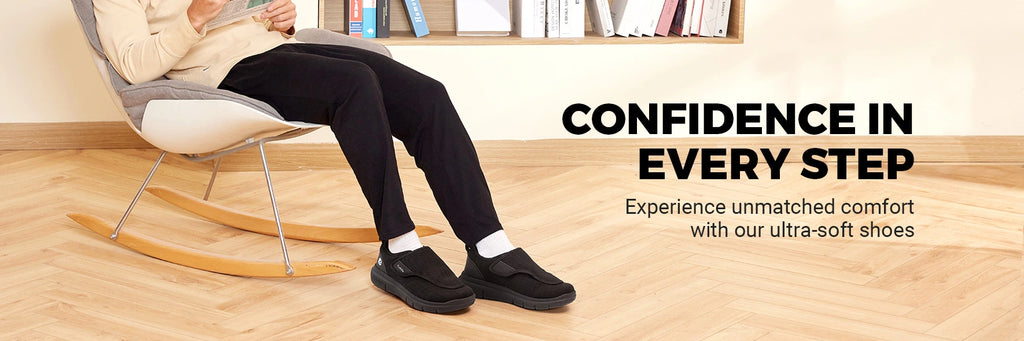
FitVille — Travel-friendly walking shoes built around 2E and 4E width options and a low-profile silhouette that does not scream sneaker. Designed for men whose feet swell on flights and who want one pair that handles cobblestones without looking out of place at dinner.
Comparison: specific models
| Model | Stack | Width options | Silhouette | Best for |
|---|---|---|---|---|
| HOKA Clifton 9 | 32 mm | D, 2E, 4E | Athletic, chunky | Maximum-cushion days, less style-conscious travelers |
| HOKA Bondi 9 | 39 mm | D, 2E, 4E | Very chunky | 25K+ step days where comfort beats everything |
| On Cloud 5 | 28 mm | D only | Sleek, Euro-friendly | Lower-mileage trips where silhouette matters |
| Allbirds Tree Runner | 24 mm | D only | Casual sneaker | All-in-one pair for café-heavy itineraries |
| ECCO Soft 7 | 22 mm | D, wide | Leather, dressy | Dinner-friendly, Strategy B all-in-one |
| FitVille Rebound Core V9 | 30 mm | D, 2E, 4E | Low-profile walking | Wide feet, swelling, mixed itineraries |
Prices across these models land in the $100–$180 band, which is where most travel-shoe budgets sit anyway.
Break-in and the sock-and-insole question
A new shoe needs roughly 20–30 miles of real walking before a long trip. Park errands, neighborhood loops, a Saturday museum afternoon at home — all count. What you are looking for is the foam compressing into your gait, the upper softening over your bunion line, and any seam friction surfacing before you are 5,000 miles from your sock drawer.
Sock strategy for flights and 20K-step days:
- Merino wool blend, mid-cushion, crew length. Wool regulates moisture better than cotton and dries overnight in a hotel sink.
- Pack four pairs minimum for a week. Rotate, never re-wear sweaty socks.
- For long-haul flights, change into compression socks at the gate and into your walking socks before landing. Swollen feet cram into walking shoes; compression sleeves keep that swell to a minimum.
Insoles. If your walking shoe has a removable footbed, consider swapping in a slightly thicker aftermarket insole for trips with above-average mileage. It adds half a size of room around the toe — useful for swelling — and shifts pressure off the ball of the foot. Do not do this the day before you fly. Test the combination on a 10K-step weekend at home.
City-by-city: what each itinerary actually demands
Paris — museum days, evenings out. Long marble floors at the Louvre and d'Orsay are a cushioning test more than a grip test. Paris also has a cocktail-bar scene where a low-profile shoe earns its keep at 10 p.m. Cobblestones in the Marais and Montmartre are real but not extreme. Lean toward a sleeker silhouette over maximum stack height.
Rome — ruins, gravel, sampietrini. The Forum and Palatine Hill are loose gravel and uneven stone. Trastevere alleys are sampietrini cubes that will roll a soft outsole. Rome is the hardest grip test on the corridor. Lugged outsole, moderate stack, breathable upper for August heat.
Amsterdam — canals, brick, bicycles. Brick paths along canals plus near-constant tram tracks and bike lanes. Wet brick is slick. Amsterdam's grip demands are different from Rome's — less uneven, more slippery. Water-resistant upper earns its keep here roughly 60% of trip days year-round.
Barcelona — Gothic Quarter, beach, Gaudí. Smooth marble and worn limestone in the Gothic Quarter; some sand transition near Barceloneta. Heat is the bigger factor than grip — breathable mesh or perforated leather over Goretex if you are traveling May–September.
Where FitVille fits
FitVille's approach is straightforward: travel-friendly walking shoes in 2E and 4E widths with low-profile silhouettes that work for mixed-context days. The Rebound Core V9 is the model most Europe-bound men land on — a 30 mm stack that handles 20K-step days, an outsole that grips wet cobbles, a wide toe box that gives swollen flight-feet somewhere to go, and a colorway range muted enough to pass at a wine bar without explanation.
It is not the dressiest shoe on this list — ECCO wins that — and it is not the most cushioned — HOKA wins that. It is the most versatile when your week includes a 22K-step day at the Vatican and a dinner where you would prefer not to look like you came from the airport.
FAQ
Can I wear sneakers to a Michelin-starred restaurant in Europe?
Most one- and two-star restaurants in Europe accept clean, low-profile sneakers, especially leather or knit in dark colors. Three-star and old-school institutions still expect a leather shoe. Check the restaurant's dress code on its website; when in doubt, pack one dressier pair.
Are running shoes good for walking around Europe?
They work, but they are over-engineered for the job. Running shoes have aggressive forefoot rocker geometry tuned for forward propulsion at 6 mph, not for standing in line at the Uffizi for 90 minutes. A dedicated walking shoe — flatter geometry, more stable platform, more durable outsole — performs better at travel pace.
Do I really need waterproof shoes for a summer Europe trip?
Goretex traps heat and is overkill in July. A water-resistant treated upper or a quick-drying mesh handles summer drizzle fine. Save full waterproofing for October–April travel or destinations like Edinburgh, Dublin, or coastal Norway.
How many pairs should I pack for a 10-day trip?
Two is the sweet spot — one walking pair, one dressier pair. One pair works if you commit to an all-in-one silhouette. Three pairs is overkill for any carry-on traveler.
My feet swell on flights. What size should I order?
Order your normal length and prioritize a wider width — 2E or 4E — over going up half a size. Extra length lets your foot slide forward on downhills; extra width gives swelling somewhere to go without bunching the upper.
Can I break in a new pair of shoes during the first few days of the trip?
No. This is the single most reliable way to ruin a trip. Walk 20–30 miles in any new pair before you fly. Hot spots, seam friction, and width issues all surface in the first 15 miles — better to find them at home.
Pack the right shoes — at 25% off
Use code AFS25 for 25% OFF sitewide on FitVille walking shoes built for travel weeks. Low-profile silhouettes, 2E and 4E widths, and the kind of outsole that does not embarrass you on Roman cobbles.
References
- HOKA Clifton 9 product specifications. HOKA
- HOKA Bondi 9 product specifications. HOKA
- On Cloud 5 product specifications. On Running
- Allbirds Tree Runner product specifications. Allbirds
- ECCO Soft 7 men's product specifications. ECCO
- ECCO Biom 2.1 men's product specifications. ECCO
- FitVille Rebound Core V9 product page. FitVille
- FitVille Fresh Picks collection. FitVille




