


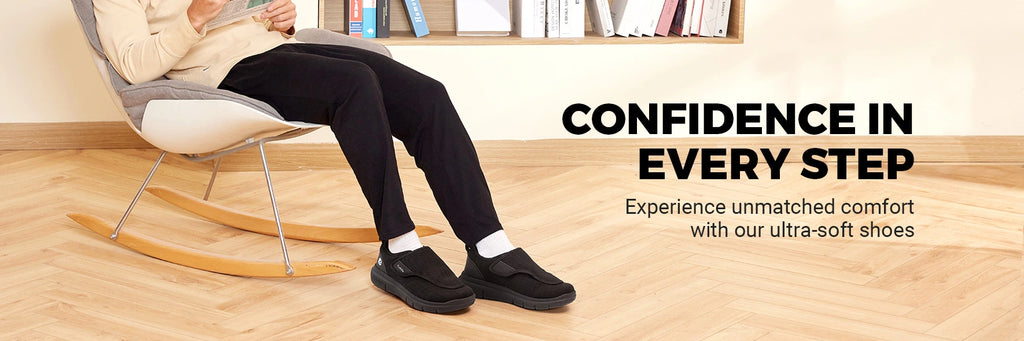
Best Walking Shoes for Seniors 2026: 4 Key Features
A good walking shoe for an older adult isn't a "senior shoe." It's a shoe that gets four things right. The footwear industry loves to sell age as a category — beige, orthopedic-looking, marketed with a faintly apologetic tone — and most of that is noise. What an active 70-year-old daily walker needs and what a more cautious 82-year-old needs are not different kinds of shoe. They are the same four functional qualities, dialed to taste: a stable base, a grippy outsole, easy entry, and low weight.
This guide is written for two readers. The first is shopping for themselves — you walk most days, you have opinions, and you have no interest in a shoe that announces your age. The second is shopping for a parent, often from another city, unsure of the size and quietly worried about steady footing on a tile kitchen floor. Both of you are in the right place. We will work through the four needs in plain terms, then close with a practical section on buying for someone else.
Shop walking shoes at FitVille Fresh Picks — use code AFS25 for 25% off sitewide.
The four functional needs, at a glance
Before the detail, here is the whole framework on one screen. Every recommendation below maps back to one of these four.
- Stability and a confident base. A slightly wider platform and a structured heel give the foot a predictable, even surface to land on and roll through — which supports a stable, confident stride.
- Slip resistance. A genuinely grippy outsole — the right rubber, the right tread, enough contact area — helps on the surfaces that actually matter: indoor tile, a wet bathroom floor, a damp morning path.
- Easy entry. Hands-free step-in heels, wide adjustable straps or laces, and large pull tabs make getting the shoe on and off a non-event for anyone who finds bending or fine finger work harder than it used to be.
- Low weight. A lighter shoe is easier to clear off the ground through the swing phase of each step, which reduces toe-drag and keeps the stride smooth.
Notice what is not on the list: nothing about age, decline, or limitation. These are the same qualities a podiatrist would point a 45-year-old toward. They simply matter more, and more visibly, the more walking you do.
Need one: stability and a confident base
Stability in a walking shoe is mostly geometry, and it is worth knowing what to look at on the shelf or the product page.
A slightly wider platform — the footprint of the sole, especially under the heel and forefoot — gives each step a broader, more predictable surface. Think of it as the difference between standing on a wide plank and a narrow beam. A wide, flat-enough base supports an even, confident stride without you having to think about it.
A structured heel counter is the firm cup at the back of the shoe that wraps your heel. Press the back of any shoe between your thumb and finger: if it collapses easily, it will not hold your heel in place over a 30-minute walk. A heel that stays put keeps the foot centered on that wide platform instead of rocking toward the edge.
Two terms worth knowing in plain language. Toe-spring is the slight upward curve at the front of the shoe — the toe tips off the ground a little even when you are standing still. It helps the foot roll forward smoothly at the end of each step instead of catching flat. A beveled heel is a heel whose back edge is rounded or angled rather than cut square. It smooths the moment of ground contact, so the heel meets the floor on a gentle curve rather than a hard corner. Together, toe-spring and a beveled heel make ground contact feel less abrupt — a smoother, more controlled roll from heel to toe.
What to skip: a very tall, very soft "pillow" midsole. Maximum cushioning sounds reassuring, but a stack that is both high and squishy can feel tippy, because the foot sits far from the ground on a surface that compresses unevenly. A medium stack with a firm, supportive feel gives you cushioning and a planted base. If your feet swell or you have wider feet, getting the fit right matters as much as the shoe itself — our guide to how walking shoes should fit covers the toe-room and width checks.
Need two: slip resistance
A grippy outsole helps on slick floors. That is the honest, useful version of the claim — no shoe "prevents" anything, but the right rubber under your foot is a real, tangible advantage on a wet tile bathroom or a kitchen floor someone just mopped.
Three things determine whether an outsole actually grips:
- Rubber compound. Softer, stickier rubber conforms to the micro-texture of a smooth floor and grips better than a hard, glassy compound. Hard outsoles last longer but slide more on wet tile. For indoor and mixed use, a softer compound is the better trade.
- Tread pattern. You want a pattern with edges and channels — small lugs or sipes that bite the surface and give water somewhere to escape from under the foot. A nearly smooth outsole has nothing to grip with once a floor is wet.
- Contact area. A broad, flat outsole that meets the floor across most of its surface grips better than a narrow or heavily curved one that only touches in patches. This overlaps with need one — a wide, stable base is also a grippier base.
Match the outsole to where the walking actually happens. Mostly indoors on tile and hardwood, with trips across a wet bathroom floor? A softer compound with a fine, edged tread is ideal. Outdoor paths and damp grass in the mix? You want slightly deeper tread for the looser surface. The worn-smooth outsole on a five-year-old pair is one of the clearest signals it is time for a replacement — more on that in the parent section below.
Need three: easy entry
Bending down to the floor and doing fine finger work with laces are two of the small daily tasks that quietly get harder — for a hundred ordinary reasons, from a stiff back to arthritic hands to simply not wanting to bother. A shoe that solves this gives back a small piece of independence every single morning.
Three designs do the job, and they suit different people:
- Hands-free step-in. A heel firm enough to hold its shape but engineered to flex down as the foot steps in, then spring back to lock the heel — so you step in standing up, no hands. Excellent if bending is the obstacle. The thing to check: the heel must spring back. A heel that stays collapsed has become a backless clog, which gives up the stability of need one.
- Wide, adjustable straps. A broad hook-and-loop strap opens the shoe wide for an easy step-in, then closes with one motion and adjusts through the day as feet swell. The most forgiving option for feet that change volume, and easy for arthritic hands.
- Large pull tabs and stretch laces. A generous loop at the heel gives a real grip for pulling the shoe on; elastic or toggle laces let a shoe stay tied yet still slide on. A good middle ground for someone who likes the look and security of a laced shoe.
There is genuine overlap between this section and a whole category of footwear built around it — if easy entry is the deciding factor, our dedicated guide to slip-on and hands-free walking shoes goes deeper on how the step-in mechanism works and how to tell a supportive pair from a flimsy one.
Need four: low weight
Weight is the need shoppers most often overlook, and it has a clear mechanical reason behind it.
Every step has a swing phase: the moment one foot lifts off the ground and travels forward to land ahead of you. A heavier shoe makes that swing take more effort and lowers your margin for clearing the ground. When the margin shrinks, the toe can catch — that small scuff or stumble on a flat surface. A lighter shoe lifts and swings with less effort, so the foot clears the ground more easily and the stride stays smooth and controlled.
You do not need the lightest shoe on the wall — featherweight shoes often shed weight by cutting the structure and grip that needs one and two depend on. You want a sensible balance. As a rough guide, a supportive walking shoe in the range of roughly 9 to 12 ounces for a typical men's size, and 7 to 10 ounces for a typical women's size, is light enough to swing easily while keeping a real heel counter, a real outsole, and real cushioning. Pick the shoe up. If it feels like a brick, keep looking. If it feels like nothing at all, check that it still has the structure of the first three needs.
Shop the FitVille Fresh Picks collection — use code AFS25 for 25% off sitewide.
A note on width and swelling
One practical detail cuts across all four needs: many feet get wider over the years, and most feet swell through the day. A shoe that fits at 9 a.m. can feel tight by 4 p.m.
That makes two things matter. First, a wide toe box — room across the front of the shoe so the toes sit in their natural toe splay rather than being squeezed to a point. Second, width options beyond standard — a true wide (2E) or extra wide (4E) fitting, not just a longer size. Sizing up in length to chase width room is a common mistake: it creates heel slip and a sloppy ride, which undermines the stability of need one. If your feet swell noticeably or you have always found shoes tight across the ball of the foot, our guide to shoes for swollen feet explains how to fit for daily volume change.
How the four needs compare across popular models
A like-for-like look at four current walking shoes, each at the same level — brand, series, generation. Use it as a starting frame, not a verdict; the right pick is the one that fits your foot.
| Model | Price (USD) | Width options | Easy entry | Approx. weight (men's) | Outsole grip focus |
|---|---|---|---|---|---|
| FitVille Rebound Core V9 | $79.99 | Standard, 2E, 4E | Easy-entry construction, large pull tab | ~10.5 oz | Broad multi-surface tread, indoor + path |
| Skechers GO WALK 6 | ~$80 | Standard, some wide | Slip-in heel on select styles | ~7 oz | Smooth-to-light tread, indoor-leaning |
| HOKA Bondi 9 | ~$170 | Standard, wide | Standard lace, large heel pull | ~10.8 oz | Durable rubber, road-leaning |
| New Balance Fresh Foam X 880v14 | ~$150 | Standard, 2E, 4E | Standard lace | ~10.3 oz | Road outsole, moderate tread |
A few honest reads of that table. The Skechers GO WALK 6 is the lightest and a true slip-in on many styles, but its width range is thinner and its tread is built more for smooth indoor floors than mixed outdoor paths. HOKA Bondi 9 is heavily cushioned and well made, but it sits at a premium price and its tall stack is a softer, higher ride that some walkers find less planted. The New Balance Fresh Foam X 880v14 brings a full width range including 4E but is a standard-lace shoe — no easy-entry help. The FitVille Rebound Core V9 is built to hit all four needs at once: standard/2E/4E widths, easy-entry construction, a sensible weight, and a multi-surface outsole, at $79.99.
How the Rebound Core V9 maps to the four needs
Honest, point-by-point — the same framework, applied to one shoe.
| Functional need | What the Rebound Core V9 brings to it |
|---|---|
| Stability and a confident base | Wide, stable platform and a structured heel counter for an even, planted stride |
| Slip resistance | A grippy multi-surface outsole — designed to help on indoor tile, damp paths, and mixed ground |
| Easy entry | Easy-entry construction with a large pull tab, so getting in and out doesn't mean a deep bend |
| Low weight | A lightweight build (~10.5 oz, typical men's size) that swings easily without giving up structure |
| Width and swelling | Standard, 2E (wide), and 4E (extra wide) fittings with a wide toe box for natural toe splay |
The Rebound Core V9 is $79.99 and comes in standard, 2E (wide), and 4E (extra wide). It is designed as a do-it-all daily walker rather than a specialist shoe: not a technical trail shoe, not a dress shoe. For the four needs this guide is built around — a stable base, real grip, easy entry, and low weight — it is squarely in its lane, and the wide-width range makes it a forgiving choice when you are sizing for swelling or buying for someone else.
A respectful, important note before you buy: this is footwear guidance, not a medical assessment. Anyone with a history of falls, a diagnosed balance disorder, or who uses a cane or walker should have their footwear reviewed by a physical therapist or doctor, who can account for the whole picture.
Shopping for a parent
Buying for a parent — often remotely, often without the chance to watch them try a shoe on — has its own small set of skills.
Size by proxy, carefully. Do not guess from an old shoe size; feet change. The reliable method: have your parent (or a helper) stand on a sheet of paper in the evening, when feet are at their largest, and trace around each foot with a pen held straight up. Measure the length and the width of each tracing, and fit to the larger foot — most people have one foot bigger than the other. Send those numbers against the brand's size and width chart rather than ordering a guessed size.
Choose a forgiving, return-friendly option. Until you know the fit is right, favor a retailer with a clear, easy return policy and a shoe available in multiple widths — so if standard is snug, a 2E is one exchange away rather than a lost order. A wide toe box and an adjustable closure also build in tolerance for a size that is slightly off.
Have a gentle conversation about worn shoes. Many people keep a comfortable old pair long past the point the outsole has gone smooth and the midsole has packed down flat. You do not need to make it about age. A workable script: "I just replaced mine — the grip wears down before you notice, and I felt the difference right away. Want me to grab you a pair while there's 25% off?" It frames the new shoes as a routine upgrade, not a concession. If you are not sure whether a parent's current pair is past its prime, our guide on when to replace walking shoes gives the concrete wear signals to look for.
Shop walking shoes at FitVille Fresh Picks — use code AFS25 for 25% off sitewide.
FAQ
What kind of shoes are best for elderly people?
The most useful answer is functional, not age-based: look for four things. A stable, slightly wider base for an even, confident stride; a genuinely grippy outsole for slick indoor and wet outdoor surfaces; easy entry — a step-in heel, a wide adjustable strap, or a large pull tab — so getting the shoe on doesn't require a deep bend; and a low overall weight so the foot clears the ground easily through each step. A shoe that does all four, in the right width for the foot, suits an active daily walker and a more cautious walker equally. Avoid very tall, very soft "pillow" shoes, which can feel tippy.
Are slip-on shoes safe for seniors?
A well-made slip-on or hands-free shoe can be an excellent choice — the key word is well-made. The thing that matters is the heel. A good step-in shoe has a heel counter that is firm enough to hold its shape and spring back to lock the heel in place after the foot steps in. That keeps the foot secure and supports a stable, confident stride. The design to avoid is one with a soft heel that stays collapsed once it is on, because that turns the shoe into a loose backless clog. If a slip-on has a structured, springy heel and a grippy outsole, it delivers easy entry without giving up support.
How often should an older adult replace walking shoes?
For a daily walker, plan on every 6 to 12 months, and judge it by wear rather than the calendar alone. The clearest signals: the outsole tread has worn smooth — especially under the heel and forefoot — which directly reduces grip; the midsole has compressed flat and no longer feels supportive; the shoe has lost its shape or the heel counter has gone soft. Smooth outsole grip is the one to watch most closely, since it is the quiet change that matters most underfoot. Our guide on when to replace walking shoes walks through the full checklist.
What shoes help with balance?
A shoe supports a stable, confident stride when it gets the basics right: a wider, flatter platform gives each step a broad and predictable surface; a structured heel counter keeps the foot centered on that platform; a grippy outsole helps on slick floors; and a sensible, medium cushioning level keeps you connected to the ground rather than perched on a soft, tall stack. Lower weight helps too, by making the foot easier to clear and place. No shoe can promise steadiness on its own — and anyone with ongoing balance concerns should have their footwear reviewed by a physical therapist or doctor — but a shoe that does these things well removes obstacles instead of adding them.
References
- Skechers GO WALK 6 product specifications. Skechers
- HOKA Bondi 9 product specifications. HOKA
- New Balance Fresh Foam X 880v14 product specifications. New Balance
- Footwear characteristics and walking stability in older adults — research overview. National Institute on Aging
- FitVille Rebound Core V9 product page. FitVille




