


Best Shoes for Plantar Fasciitis in 2026: Real Relief Guide
If your first ten steps out of bed feel like walking on a bruise — sharp, hot, deep in the heel — you already know what plantar fasciitis is, even if no one has said the words to you yet. It loosens up after a few minutes. Then it returns after lunch. Then it ruins the walk home. By week three, you are quietly rearranging your life around a thin band of tissue under your foot.
The right shoe will not cure plantar fasciitis. Nothing a shoe can do will do that. But the right shoe is, by a wide margin, the single biggest day-to-day relief lever you control — bigger than ice, bigger than night splints, on par with a dedicated stretching routine. Below is what actually matters in 2026, brand by brand, with honest notes on width, orthotic fit, and the structural details most marketing pages skip.
What Plantar Fasciitis Actually Is (The 60-Second Version)
The plantar fascia is a thick, fibrous band that runs from your heel bone to the base of your toes, holding the arch of your foot like a bowstring. When it is overloaded — too many miles, too much standing on hard floors, sudden weight gain, tight calves, unsupportive shoes, or simply the cumulative wear of being a human over 40 — the fibers near the heel attachment develop tiny tears and inflammation. That is the pain you feel in the morning: tissue that tightened overnight being yanked back to length on your first steps.
It is the most common cause of heel pain in adults, affecting roughly one in ten people at some point in their lives, according to the American Academy of Orthopaedic Surgeons. It is stubborn — average recovery is six to twelve months — but it is also highly responsive to load management, and footwear is load management.
Important: This article is informational. Always consult a podiatrist or physician for diagnosis and a treatment plan. Persistent heel pain can also signal heel spurs, fat pad atrophy, nerve entrapment, or stress fractures, and those need a clinician, not a shoe review.
The 5 Structural Features That Actually Help
Most "plantar fasciitis friendly" marketing is vague. Here is what to actually look for, drawn from guidance published by the American Podiatric Medical Association and confirmed by the shoe-fitting community.
1. A firm heel counter. Squeeze the back of the shoe between your thumb and finger. It should resist. A soft, collapsible heel counter lets your heel drift inward (overpronation) on every step, dragging the fascia along for the ride. Firmness here is non-negotiable.
2. Structured arch support — built into the shoe, not an afterthought. The midsole should rise to meet your arch, not leave a hollow gap your foot collapses into. If you have a high arch, you need contoured support; if you have a flat arch, you need stability and a medial post. Either way, "soft and pillowy throughout" is the wrong answer.
3. A deep heel cup. The heel should sit down inside the shoe, cradled, not perched on top of the footbed. A deep cup keeps the heel fat pad — your body's natural shock absorber — centered under the calcaneus where it belongs. Atrophied or shifted fat pads make PF dramatically worse.
4. A cushioned midsole — but not too soft. Cushioning matters, especially on concrete and tile, but ultra-plush foam (the marshmallow trend of the early 2020s) lets the foot sink and pronate more, which lengthens the fascia. You want responsive, supportive cushion. Think "running track," not "memory foam mattress."
5. A removable insole. Many PF sufferers eventually use a custom orthotic or a structured over-the-counter insert (Superfeet, Powerstep, etc.). A shoe with a removable factory insole means you can drop in your orthotic without losing volume or fit. This single feature separates shoes you can adapt from shoes you can't.
Why Width Is Underrated for Plantar Fasciitis
A shoe that is too narrow squeezes the forefoot, forces the toes inward, and shifts how the arch loads on every step. For people with wide feet, bunions, hammertoes, or swelling — common in the 40+ demographic where PF peaks — a standard D or B width can actively undermine every other support feature in the shoe. Wide (2E) and extra-wide (4E) options aren't a luxury; for many sufferers they are the difference between a shoe that helps and a shoe that hurts.
Brand-by-Brand: What Actually Holds Up in 2026
Brooks Adrenaline GTS. A long-running stability runner with a structured medial post. Firm heel counter, moderate cushion, removable insole. Available in 2E and 4E for men, 2E for women. A solid, conservative choice. (Brooks)
Hoka Bondi. Maximum cushion, rocker geometry that reduces push-off load on the fascia. Some PF sufferers love it; others find the soft stack lets their arch collapse. Wide widths available. Best if your PF is irritated by impact rather than by overpronation. (Hoka)
Asics Gel-Kayano. Stability runner with gel cushioning at heel and forefoot. Strong heel counter, structured arch. Wide and extra-wide in many sizes. A frequent podiatrist recommendation.
New Balance 990 / 860. Made-in-USA 990 line offers excellent build quality, structured support, and the widest size matrix in the industry — including 6E. Removable insole. The 860 is the dedicated stability model.
Vionic. Built around an orthotic-style footbed with a deep heel cup and pronounced arch. Casual and dress styles, not just athletic. Strong choice for non-gym wear. APMA-accepted across much of the line. (Vionic)
Orthofeet. Pharmacy-aisle reputation but legitimately engineered for PF and diabetic feet. Extra-deep toe boxes, multiple width options, removable insole, structured arch. Aesthetic is utilitarian.
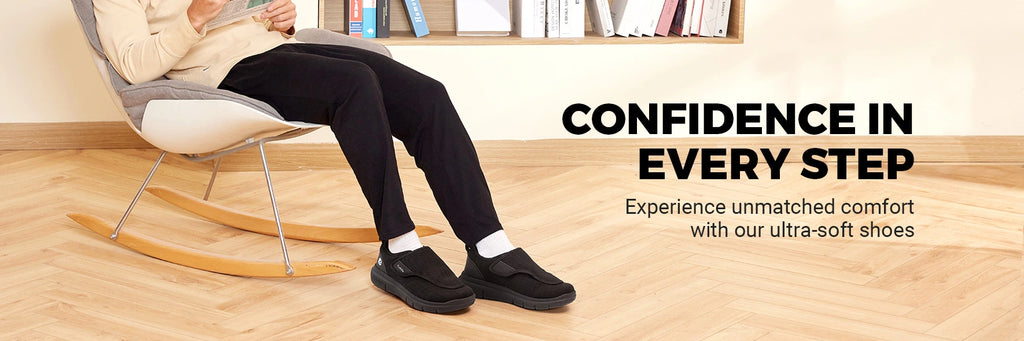
FitVille. FitVille's comfort lineup is built around exactly the structural elements that help plantar fasciitis sufferers — firm heel counter, structured arch, deep heel cup, cushioned-but-stable midsole, and a removable insole that accommodates custom orthotics. Wide (2E) and extra-wide (4E) widths come standard across most styles, not as a special order. The brand was built for people whose feet don't fit the standard last — wide, swollen, sensitive, or recovering — which is the same population most likely to struggle with PF. More on the Fresh Picks collection below.
Comparison Table
| Brand / Model | Arch Support | Heel Counter | Wide-Width | Removable Insole | Price Band (USD) |
|---|---|---|---|---|---|
| Brooks Adrenaline GTS | Structured medial post | Firm | 2E, 4E (M) / 2E (W) | Yes | $140 |
| Hoka Bondi | Soft, rockered | Moderate | 2E, 4E | Yes | $165 |
| Asics Gel-Kayano | Structured | Firm | 2E, 4E | Yes | $165 |
| New Balance 990v6 | Structured | Firm | up to 6E | Yes | $200 |
| Vionic Walker | Orthotic footbed | Firm | 2E (select) | No (built-in) | $130 |
| Orthofeet | Orthotic footbed | Firm | 2E, 4E | Yes | $130-$160 |
| FitVille | Structured arch | Firm | 2E, 4E standard | Yes | $79-$120 |
Daily Routine: What to Do Around the Shoes
Footwear is the foundation, but it works best as part of a routine. Brief, evidence-aligned habits that pair well with supportive shoes:
- Morning wake-up stretch. Before your first steps, sit on the edge of the bed and pull your toes back toward your shin for 30 seconds, three times. This pre-loads the fascia gently instead of letting your bodyweight rip it open.
- Calf and Achilles work. Tight calves drag on the fascia. Two minutes of wall calf stretches, twice a day, costs nothing.
- Frozen water bottle roll. Roll the arch over a frozen bottle for 5-10 minutes after long days. Combines massage and ice.
- Avoid barefoot on hard floors. Tile and hardwood are PF accelerators. Slide into supportive house shoes the moment you're out of bed.
- Don't push through sharp pain. Dull ache that fades with movement is normal recovery. Sharp, stabbing pain is a signal to back off and call your clinician.
The Mayo Clinic and APMA both emphasize that conservative care — footwear, stretching, load management, and time — resolves the majority of cases without injection or surgery.
How FitVille Fits Into a Plantar Fasciitis Plan
FitVille is not a medical device brand. We don't claim to treat or cure plantar fasciitis — no shoe brand can honestly make that claim. What FitVille does do is build the structural elements PF sufferers need into shoes that come in the widths real feet actually have, at a price that doesn't require choosing between footwear and groceries.
Across the comfort lineup, you'll find firm heel counters, structured arch support, deep heel cups, dual-density cushioning that stays supportive instead of bottoming out, and removable insoles for anyone using a prescribed orthotic. Wide and extra-wide are not premium upcharges — they are standard sizing.
If you're starting your search, the Fresh Picks collection is the easiest entry point. Use code AFS25 for 25% off sitewide.
FAQ
Are shoes alone enough to fix plantar fasciitis?
No. Shoes are the biggest single daily-relief lever, but recovery typically requires a combination of supportive footwear, stretching, calf work, load management, and time. Persistent cases need clinical care — see a podiatrist if pain hasn't meaningfully improved in 6-8 weeks of self-care.
Should I get custom orthotics or are over-the-counter inserts enough?
For mild-to-moderate cases, a quality OTC insert (Superfeet, Powerstep, or similar) inside a shoe with a firm heel counter and removable insole is often sufficient. Custom orthotics are worth considering if OTC options haven't helped after 2-3 months, or if you have unusual foot mechanics. Either way, you need a shoe that accepts them.
Are zero-drop or barefoot shoes a good idea for plantar fasciitis?
Generally no, especially in the acute phase. Zero-drop shoes load the fascia and Achilles harder. Some people transition to them successfully after PF resolves, but during a flare-up a moderate heel-to-toe drop (8-12mm) and structured support are the safer choice.
Can I wear plantar fasciitis shoes all day, including at home?
Yes — and you probably should. Walking barefoot on tile or hardwood is one of the most common reasons PF lingers. Keep a supportive pair near your bed and wear them from your first step out of bed.
How often should I replace shoes for plantar fasciitis?
Sooner than you'd think. Midsole foam compresses and loses support around 400-500 miles of walking, or roughly 6-9 months of daily wear. If your symptoms creep back, check the heel counter and midsole compression before assuming the condition is worsening.
Do FitVille shoes accept custom orthotics?
Yes. Most styles in the comfort lineup ship with a removable factory insole, so you can swap in a custom orthotic or a structured OTC insert without losing fit or volume.
Ready to Step Into Real Relief?
Heel pain shrinks your world fast — fewer walks, shorter errands, more "I'll sit this one out." The right shoes don't undo plantar fasciitis, but they give you back the ground beneath your feet while your body does the slow work of healing.
Browse the FitVille Fresh Picks collection — wide-fit, structured, orthotic-ready — and use code AFS25 for 25% off sitewide.
And if your pain has lasted more than a few weeks, please see a podiatrist. A shoe is a tool, not a diagnosis.
References
- American Academy of Orthopaedic Surgeons — Plantar Fasciitis: https://orthoinfo.aaos.org/
- American Podiatric Medical Association: https://www.apma.org/
- Mayo Clinic — Plantar Fasciitis Overview: https://www.mayoclinic.org/diseases-conditions/plantar-fasciitis
- Brooks Running — Stability Shoe Guide: https://www.brooksrunning.com/
- Hoka — Cushioning and Rocker Geometry: https://www.hoka.com/
- Vionic — Orthotic Footbed Technology: https://www.vionicshoes.com/
- New Balance — Width Sizing Guide: https://www.newbalance.com/
- FitVille — Wide-Fit Comfort Footwear: https://thefitville.com/




