


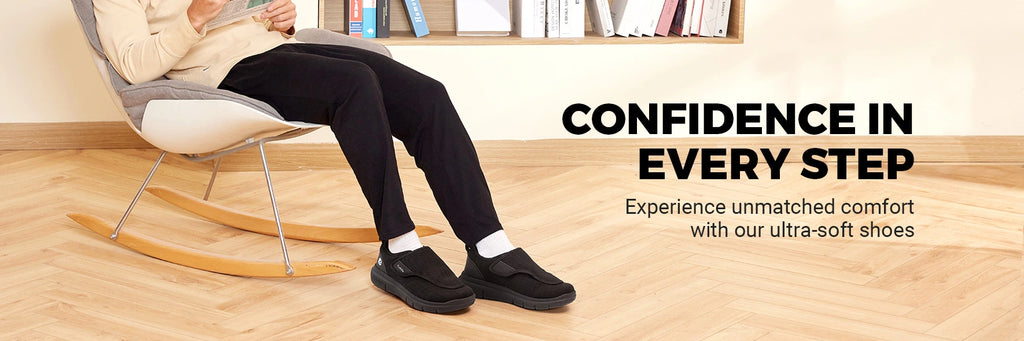
Adjustable Shoes for Seniors with Limited Hand Mobility
“Easy on” can mean several different things. One shoe opens wide but needs a strong pull on a small tab; another can be entered hands-free but offers little adjustment afterward. The best adjustable shoes for seniors with limited hand mobility match the person's real dressing routine, seated reach, grip, foot shape, and walking needs.
Evaluate the Entire On-and-Off Routine
Test footwear from the position normally used for dressing. If the person sits, place the shoe where it would actually be and note whether they can reach the closure, hold the tongue, guide the foot in, and secure the shoe without rushing.
The opening needs to be large enough for entry, but the finished fit must still hold the heel. Easy removal alone is not enough if the foot slides while walking.
| Closure type | Potential advantage | Check carefully |
|---|---|---|
| Broad hook-and-loop strap | Large target and adjustable volume | Grip force, tab size, strap overlap |
| Hands-free heel | Little or no bending to pull the heel on | Heel security and correct entry technique |
| Zipper | Quick repeated opening | Tab size, path, and need to stabilize the shoe |
| Elastic lace | No bow tying | Whether tension can be adjusted enough |
| Slip-on stretch panel | Simple construction | Opening effort and heel movement |
Small Details Change Accessibility
A large loop can be easier to grasp than a flat fabric edge. High-contrast tabs may be easier to locate visually. A strap that stays attached when fully open is harder to lose and easier to reset. The tongue should remain out of the opening rather than folding under the foot.
For a hook-and-loop shoe, check the full adjustment range. The strap should overlap securely without ending at its limit, and extra material should not drag on the floor. Test whether it can be opened with one hand if that is part of the user's routine.
Fit Still Comes First
Choose the correct length and enough forefoot width for natural toe splay. Do not use a larger size solely to make entry easier; extra length can reduce control. The heel should remain seated, and the foot should stay supported over the sole platform.
Try shoes later in the day with the intended socks. Walk indoors, turn, and use a step if safe to do so. If an orthosis is prescribed, test the shoe with that exact device because it changes depth and closure range.
Limited hand mobility can have many causes. A clinician or occupational therapist can help evaluate dressing strategies or adaptive devices when the routine remains difficult. Footwear should not be described as preventing falls or treating the underlying condition.
Independence Without Assumptions
Some older adults want a fully hands-free design; others prefer an adjustable strap because it provides clear feedback and control. A caregiver may help with the first fitting without becoming part of every daily routine. Ask the wearer which step is hardest and optimize for that step.
Return policies matter because a showroom demonstration does not reproduce the home environment. Keep the shoes clean and test them indoors until the user can repeat the routine comfortably.
Where FitVille Fits
FitVille's EasyTop collection includes wide, adjustable-entry designs intended to simplify access. Compare tab size, strap range, heel design, and live width availability on the exact product page. The right choice is the model the wearer can operate and walk in securely—not merely the one with the easiest marketing label.
Shop Fresh Picks with code AFS25
Use code AFS25 for 25% OFF sitewide when the promotion is active.
Try-On Checklist
- Recreate the normal seated or standing dressing position.
- Test opening, entry, fastening, walking, and removal.
- Check tab size and required grip force.
- Leave enough toe room without creating excess length.
- Confirm heel security after fastening.
- Re-test with prescribed inserts and usual socks.
FAQ
Are hook-and-loop shoes the same as hands-free shoes?
No. Hook-and-loop footwear still requires opening and closing a strap. Hands-free designs are intended to accept the foot without pulling the heel, though their fit and technique vary.
Are adjustable shoes only for swollen feet?
No. Adjustment can also help with a high instep, different sock thicknesses, orthoses, or a need for a wider opening.
Can easy-on shoes prevent falls?
No shoe can make that guarantee. Secure fit and suitable traction are important, but fall risk is broader and should be discussed with an appropriate professional.




