


6E Wide Walking Shoes for Men: A Fit-First Guide
Finding 6E wide walking shoes for men is harder than filtering a product list. Width codes are not perfectly standardized across brands, and two 6E shoes can differ in toe shape, instep volume, heel width, and usable length. Treat 6E as the beginning of the fit process—not proof that a shoe will work.
What 6E Does and Does Not Tell You
A 6E label generally signals a very wide men's fit within that brand's system. It does not provide one universal internal measurement. The last, upper material, lacing pattern, and thickness of the insole all affect the space you can actually use.
Check five zones independently:
| Fit zone | A useful result |
|---|---|
| Toes | They rest naturally without touching the front or sides. |
| Ball of foot | It aligns with the shoe's widest flex area. |
| Instep | Upper closes securely without concentrated pressure. |
| Heel | It stays seated without harsh rubbing. |
| Platform | The foot does not visibly overhang the sole. |
Buying a longer size to obtain width can move the flex point too far forward and create heel slip. Start with your measured length, then compare the brand's wide options and model-specific guidance.
Measure and Try On More Consistently
Measure both feet later in the day while wearing your normal walking socks. Fit the larger foot and note both length and width. If possible, use a Brannock-style device with help from an experienced fitter; an outline on paper is a useful screening tool but not a complete measurement.
During try-on, lace or fasten the shoe as intended. Walk, turn, use stairs, and pause on an incline. Check the longest toe, the little-toe joint, and the top of the instep. Heel movement should be minimal, but the collar should not bite.
If the insole is removable, an approved thinner or thicker insert changes internal volume. Re-test the entire fit whenever you change it rather than assuming the width remains equivalent.
When an Adjustable Upper Helps
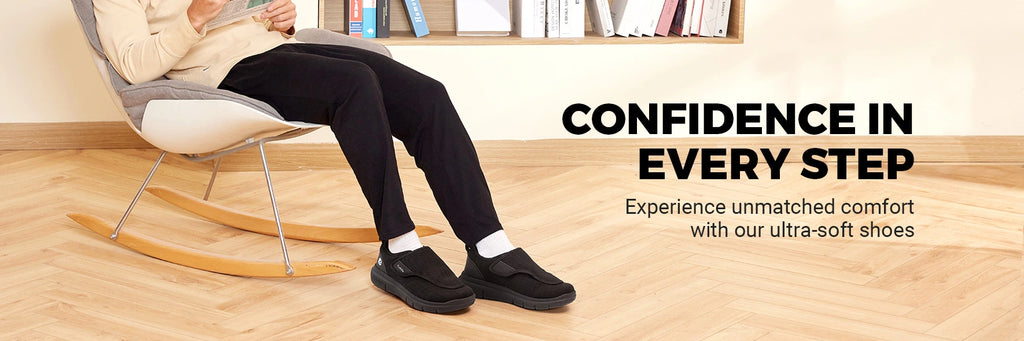
Men with a high instep or a fit that changes during the day may benefit from broad hook-and-loop straps or a lacing system with a generous opening. Adjustment should distribute pressure, not merely clamp the top of the foot. Confirm that the strap has enough overlap in both directions and that its edge does not sit on a sensitive spot.
An easy opening is also useful for dressing, but heel hold still matters. Walk briskly and climb a few steps to make sure the convenience feature does not allow the foot to slide.
Compare Construction, Not Just Width
For regular walking, look for a stable base, forefoot flexibility at the natural flex point, and tread suited to your route. Very soft foam is not automatically more comfortable. A tall or narrow platform can feel less controlled, particularly when a broad foot extends beyond it.
Read return terms before wearing a specialty-width shoe outdoors. Inventory can be limited, so an indoor evaluation window is valuable.
Where FitVille Fits
The FitVille Men's EasyTop StrapEase V4 is designed for adjustable entry and is offered in specialty wide-fit options; confirm the live size-and-width selector for current availability. The FitVille Rebound Core collection also includes a current men's 6E option. Neither width label replaces a full try-on.
Shop Fresh Picks with code AFS25
Use code AFS25 for 25% OFF sitewide when the promotion is active.
Buying Checklist
- Measure both feet with your intended socks.
- Read the exact model's width chart.
- Check toe shape, instep volume, heel hold, and platform width.
- Test closures through their full usable range.
- Walk indoors before committing the pair.
- Keep packaging until the fit decision is final.
FAQ
Is 6E the same in every men's shoe brand?
No. Width conventions and lasts vary. Compare the brand's chart and evaluate the exact model on your foot.
Is 6E wider than extra wide?
Usually, but the retail words “wide,” “extra wide,” and “extra-extra wide” are used inconsistently. The letter code and model measurements are more useful when the brand provides them.
Should a 6E walking shoe feel loose?
It should feel roomy across the forefoot, not loose everywhere. The heel and midfoot still need a secure, comfortable hold.
References
- Shoe-selection guidance. American Orthopaedic Foot & Ankle Society
- EasyTop StrapEase V4 product page. FitVille
- Rebound Core collection. FitVille




