


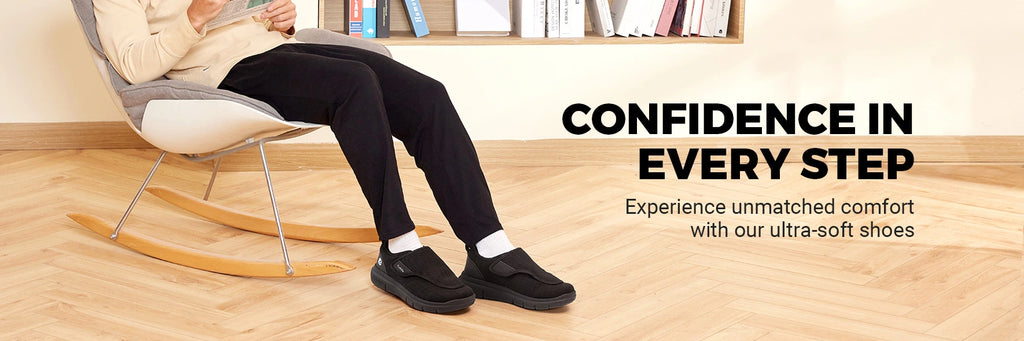
Diabetic Shoes for Swollen Feet: A Practical 2026 Guide (Medicare, Style, Stretch Fit)
Diabetic feet are a uniquely difficult fit problem. Swelling fluctuates hour-to-hour. Nerve sensitivity means you can't feel when a shoe is rubbing. A small friction point becomes a pressure wound becomes something much worse. Regular shoes — even good comfort shoes — don't solve this. You need shoes designed for the specific combination of swelling, sensitivity, and width instability that comes with diabetes.
This guide covers how diabetic shoe requirements actually differ from regular comfort shoes, what the Medicare Therapeutic Shoe Bill covers (US), and what to look for if you're buying on your own.
Why Diabetic Feet Need Different Shoes (It's Not Just "Bigger")
If you've been treating diabetic shoe-shopping like regular shoe-shopping with a "W" added on, you're missing the point. Three overlapping problems stack up:
Problem 1: Fluctuating Swelling
Feet can swell 10–15% over a single day, especially with poorly controlled diabetes, cardiovascular issues, or edema. A shoe that fits perfectly at 8am is a vice by 4pm. Standard leather or stiff mesh doesn't accommodate this — you need stretch uppers that expand as swelling increases.
Problem 2: Peripheral Neuropathy
Diabetic neuropathy reduces or eliminates the warning signals your feet normally send. You don't feel the rub. You don't feel the pressure point. By the time you see redness or a blister, the damage is already done. This is why diabetic shoes need:
- Seamless interiors (no stitching to irritate)
- Deep toe boxes (vertical room prevents top-of-toe ulcers from toenails pressing up)
- Smooth, padded linings
- Removable insoles (to accommodate custom orthotics or pressure-relieving footbeds)
Problem 3: Arch Collapse & Gait Changes
Long-term diabetes is often associated with Charcot foot, arch collapse, and asymmetric weight distribution. A shoe that supports the collapsed arch and stabilizes the heel reduces ulceration risk on the midfoot and ball of the foot.
What "Diabetic-Friendly" Really Means (Feature Checklist)
When you see "diabetic shoe" on a product page, here's what should be true:
| Feature | Why it matters |
|---|---|
| Stretch fabric upper | Accommodates daily swelling without friction |
| No interior seams at forefoot | Prevents rubbing on insensate skin |
| Extra-depth toe box (vertical + horizontal) | Room for hammer toes, bunions, neuropathy-padded insoles |
| Removable insole (at least 5mm depth) | Fits custom orthotics or pressure-relief inserts |
| Firm heel counter | Controls rearfoot motion, reduces plantar/midfoot shear |
| Rocker sole or rolled bottom | Reduces peak pressure on forefoot during push-off |
| Wide-width options (2E / 4E) | Covers both naturally-wide and swollen-from-edema feet |
| Lightweight construction | Reduces muscle fatigue and gait changes |
| Velcro or stretch-laces option | Easier for reduced hand dexterity (common in older diabetics) |
If a shoe is missing 3+ of these, it's not genuinely diabetic — it's marketing.
Medicare Therapeutic Shoe Bill (US): What's Covered
US-only, but important to know if you or a parent is on Medicare:
The Medicare Therapeutic Shoe Bill (part of the Diabetic Shoe Program) covers one pair of shoes plus three pairs of inserts per calendar year — provided:
- You have diabetes (type 1 or 2)
- Your primary-care doctor documents at least one qualifying condition: prior ulceration, foot deformity, peripheral neuropathy with callus, poor circulation, or amputation on the other foot.
- A podiatrist or qualified foot specialist prescribes the shoes.
- The shoes come from a Medicare-approved supplier.
Covered brands often include Orthofeet, Propet, Drew, Dr. Comfort, Apex. If you go outside that list (e.g. FitVille, which isn't Medicare-approved), you pay out of pocket — but prices are typically 40–60% below Medicare-approved equivalents because you're skipping the supplier markup.
The trade-off: Medicare-approved = free or near-free, but styling is dated and selection is limited. Out-of-pocket therapeutic shoes (DTC brands) = $60–$100, modern styling, faster shipping.
What About the UK and Canada?
UK: The NHS provides orthotic footwear on prescription for patients with diabetic foot ulcers or advanced complications, but supply varies by Clinical Commissioning Group. Many UK diabetic patients buy privately from Cosyfeet, DB Shoes, or increasingly DTC brands that ship to the UK (FitVille, Orthofeet international).
Canada: Some provincial health plans and most private extended health plans cover orthotic footwear with a podiatrist's prescription. Check with your plan's "orthotic appliances" allowance.
Styles That Actually Work (Not "Medical Beige")
One of the biggest emotional barriers to diabetic shoes is aesthetics. Traditional Medicare-covered shoes are famously dated — they signal "I have a condition" every time you put them on. That matters; people resist wearing shoes they hate.
The DTC therapeutic category has closed this gap in the last 3–5 years. FitVille, for example, builds its diabetic line around the same chassis as its mainstream wide-fit line, so the shoes look like regular athletic sneakers but incorporate the stretch upper, removable insole, extra-depth toe box, and rocker sole features above.
If you're buying for a parent who's been refusing to wear their prescribed shoes because "they look like hospital shoes," switching to a mainstream-styled DTC option often gets them to actually wear the shoes — which is the entire point.
Browse FitVille's diabetic-friendly wide-fit collection →
Practical Shopping Tips
Measure at the end of the day, not the morning
Your feet are largest late afternoon/evening. Measuring in the morning gives you a shoe that's too tight by 5pm.
Measure both feet, size up to the larger one
30–40% of adults have meaningfully asymmetric feet. Fit to the larger foot; add a pad to the smaller side if needed.
Do the "pinch test" at the forefoot
With the shoe laced, pinch the material across the widest part of your forefoot. You should be able to gently pinch a small fold. Zero fold = too tight. Big bunching fold = too loose.
Wear diabetic-appropriate socks when fitting
Cotton socks retain moisture. Look for non-binding diabetic socks — usually merino wool or specific synthetics with no tight elastic cuff. Bring these when you try on shoes or your fit will be off.
Check for pressure points after 2-hour wears
Neuropathy means you won't feel problems. Visual inspection of your feet after each wear is non-negotiable: look for redness, warmth, or small abrasions. Any red flag = stop wearing and consult.
Common Mistakes (and How to Avoid Them)
- Buying "wide" instead of "diabetic wide" — regular wide shoes address width but miss stretch upper and seamless interior.
- Using old insoles in new shoes — worn insoles lose their pressure-distribution properties. Refresh every 6 months.
- Ignoring the insole height — if you use custom orthotics, the shoe must have removable insoles of adequate depth or your orthotic will sit too high.
- Going too soft — ultra-cushioned shoes (Hoka Bondi, thick Skechers) feel amazing but lack the heel stability diabetics with Charcot or arch collapse need.
- Wearing shoes past their life — diabetic shoes lose their pressure-distribution properties faster than regular shoes due to constant swelling pressure. Replace every 400–500 miles or every 9–12 months for daily wear.
When to See a Podiatrist Immediately
- Any open wound or ulceration on the foot
- Skin that stays discolored (red, purple, dark) after shoe removal
- Any area that feels hot to the touch
- Changes in foot shape (possible Charcot foot — medical emergency)
- Sudden increase in swelling (could indicate circulatory or kidney changes)
Diabetic foot care is not a footwear problem alone. Shoes reduce risk; they don't eliminate it. Annual podiatry exams + daily self-inspection + well-controlled blood glucose remain the foundation.
FAQ
Can I wear regular wide shoes if I have mild neuropathy?
Probably not. Mild neuropathy still means reduced sensation — the primary protection gap that requires seamless interiors and stretch uppers. You don't feel the rub until the damage is already done.
Are diabetic shoes and orthopedic shoes the same?
Overlapping, but not identical. Orthopedic shoes are prescribed for structural foot conditions (clubfoot, severe deformities). Diabetic shoes focus on pressure distribution, protection of insensate skin, and accommodation of swelling.
How often should I replace diabetic shoes?
Every 9–12 months for daily wear, or 400–500 miles of walking — whichever comes first. Worn shoes lose cushion and pressure distribution.
Is Rebound Core a diabetic shoe?
FitVille's Rebound Core is a wide-fit therapeutic shoe with many diabetic-friendly features (wide toe box, deep heel cup, removable insole, lightweight construction). The dedicated diabetic line has additional features (stretch upper, seamless interior) specifically for neuropathy and edema — more appropriate if you have confirmed diabetic foot complications.
This article is for general educational purposes and is not medical advice. Diabetic foot care should always involve a licensed podiatrist and your primary-care team.
Next read: Wide Toe Box Shoes for Plantar Fasciitis · Extra Wide Walking Shoes for Elderly Parents




